I’m a Clerith fan through and through, but plenty of players saw a different love story than me – they saw a romance story between Cloud and Tifa instead in the original game and subsequent Compilation. The game never spelled out who Cloud “ends up with” or has feelings for present-day, which has led to a spectrum of interpretations with two main schools of thought: Cloud loves Aeris, or Cloud loves Tifa. Now, the Final Fantasy VII fandom has a nasty reputation for its nasty ship war, incendiary rhetoric and screeching debates on who feels what for who.
Here are the facts in Final Fantasy VII.
- Final Fantasy VII had an affection mechanic built in that allowed Cloud to earn “romance points” for Aeris, Tifa, Barret, or Yuffie. By default, Aeris starts with 50 romance points right off the bat. Tifa starts with 30. Yuffie starts with 10, and Barret starts with 0.
- At the end of disc 1, whoever has the highest score will go on a date with Cloud at the Gold Saucer. In case of a tie, the priority order is Aeris > Tifa > Yuffie > Barret. This makes Aeris the default date, but Tifa isn’t hard to romance either.
- Aeris dies at the end of disc 1.
- In disc 2, Cloud will have a scene alone with Tifa under the Highwind when the party temporarily disbands. If he has achieved over 50 points with Tifa, he has a conversation with Tifa with implied emotional intimacy. If he has under 50 points, the conversation between the two is abrupt and apathetic.
- In the game’s ending, Cloud reaches for Aeris’s hand and expresses a desire to Tifa to meet Aeris again in the Promised Land.
And in Advent Children:
- Cloud and Tifa are living together in a new bar/house called Seventh Heaven, alongside Barret’s daughter Marlene and an orphan Denzel. Barret lived with them as well before departing on a journey.
- Cloud and Tifa have separate bedrooms. While they clearly have a close friendship, they are currently strained. By the start of the movie, Cloud has disappeared without telling Tifa where he is, and is discovered to be living in Aeris’s church.
- Cloud spiritually communes with Aeris’s spirit several times throughout the film, and she even fights alongside him.
- Tifa and Cloud are never shown being romantic together. However, them patching their strained relationship – whatever it is – is important to the film.
- Cloud and Tifa consider themselves family alongside Marlene and Denzel. Barret was included in this family in the Case of Tifa novel, written by Nojima. However, of course, “family” need not be romantic.
- Cloud’s main obstacle in the film is the guilt he feels for letting Aeris die, so most of his time seems to be spent thinking about her and agonizing over her loss.
Technically, the narrative is ambiguous. However, fans of both pairings look at the story content through the lens of their preferred ship, and are therefore certain of one thing: either Cloud is forever pining over his lost love Aeris and has a platonic yet familial relationship with Tifa, or Cloud and Tifa have become a couple and Cloud’s struggles with guilt are only born out of his fear of a happy, peaceful life with Tifa.
But what do the story’s writers themselves have to say about it?
Let’s ask Tetsuya Nomura, who shared these words:

プレイヤーの感情が反映される仕掛け
「FF」では、主人公とヒロイ ンの恋の行方も重要なポイント。 「VII」では、こうしたキャラ同士の絡み合いはどうなるのか。
野村: プレイヤーによっては、「俺はティファが好きだ。いや俺はエアリスの方がいい」ということは当然あるでしょうから、それが反映される形、つまりリアクションとして返ってくる形にはしたいと思ってます。
例えば 完全な一本道にしてしまうと、 俺はエアリスが好きなのにストーリーの関係でティファとくっついちゃってる、みたいな感じにもなっちゃいますから、それはなくしたいなと。 マルチシナリオではないですけど、プレイヤーの感情が反映される仕掛けをぜひ取り入れたいですね。
Mechanic that reflects the player’s feelings
ーIn Final Fantasy, the outcome of love between the hero and heroine is also an important point. How will the characters become entwined in VII?
ーNomura: Depending on the player, it’s natural for them to say, “I like Tifa. No, I prefer Aeris,” so I wanted to shape things in reflection of that, or in other words, create a system that reacts to the players’ feelings. For example, if the game had a completely straightforward path, I might feel stuck with Tifa because of story-related reasons, even though Aeris is the one I like, it gets to feel something like that, so I wanted to get rid of that approach. It’s not that there are branching paths, but I absolutely wanted to incorporate a mechanic that reflects the player’s feelings.
Game Walker magazine
This interview, which came out around the time Final Fantasy VII was released, shares key insight into what the game was designed to be: a story where the player is invited to share his or her own feelings for Aeris or Tifa, and come to their own conclusions. The player can affect certain pseudo-romance scenes such as the date scenario and the Highwind scene through the game’s affection mechanics, and other scenes are ambiguous enough where a player can read romance if they like, or not.
He also gave a pretty clear answer on whether or not Cloud and Tifa really are a romantic couple in Advent Children.

Interviewer: By the way, how many girls has Sephiroth dated?
Nomura: What a question! I haven’t thought about it. To be honest, I don’t care who is dating who. I think it’s better to get fans to imagine and enjoy the parts that are not spelled out in the game or movie. It’s more fun to talk to friends about filling in the blanks afterwards. For instance, I’m often asked, “did Tifa and Cloud have a romantic relationship in the 2 years leading up to AC?” but I just don’t know.
Interviewer: Of course! If Mr. Nomura says “this is what it is” then that would be the setting.
Nomura: I just think that would take away the room for enjoyment.
Interviewer: That’s wonderful kindness. Thanks to that, I have lived for 8 years with wild fantasies.
Nomura: Well, shall we return back to reality? (Laughs)
~Dorimaga magazine / ドリマガ(2005 11月号)
If Cloud and Tifa were intended to be a couple, surely Nomura would be comfortable saying so. Considering Advent Children also lacks any scene demonstrating romantic or physical intimacy between Cloud and Tifa – a kiss, a romantic hug, or even an indication from another character that Tifa is Cloud’s girlfriend – we are going to have to take Nomura’s word for it. He wants fans to decide for themselves.
But Nomura doubles down with a second quote:
AC is piece of work made by Japanese people. In Hollywood movies, I think there is a tendency where the meaning of all the scenes have to be expressed clearly but, this isn’t something like that. With our work, the viewer is free to decide how they interpret or enjoy it. The staff has their own answers to all the scenes in the movie such as the angel statue that makes an appearance many times.
But, even if someone who have watched it interprets it differently then that is just another answer. I guess “comparing answers” with friends is one of the ways you can enjoy the movie. I think AC is a movie that makes those who have watched it, want to talk about it with others.
Nomura
In fact, Nomura offers an alternative explanation to Cloud and Tifa’s familial relationship as not one of husband-and-wife, but perhaps mother-and-child.
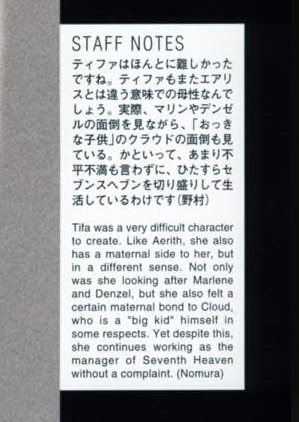
“Like Aerith, [Tifa] has a maternal side to her, but in a different sense. Not only was she looking after Marlene and Denzel, but she also felt a certain maternal bond to Cloud, who is a “big kid” himself in some respects.”
Nomura, Advent Children Reunion Files
(Nojima would corroborate this in his Case of Tifa novella, where he writes of Tifa feeling happy watching Cloud grow and wondering if this is what a mother felt like.)
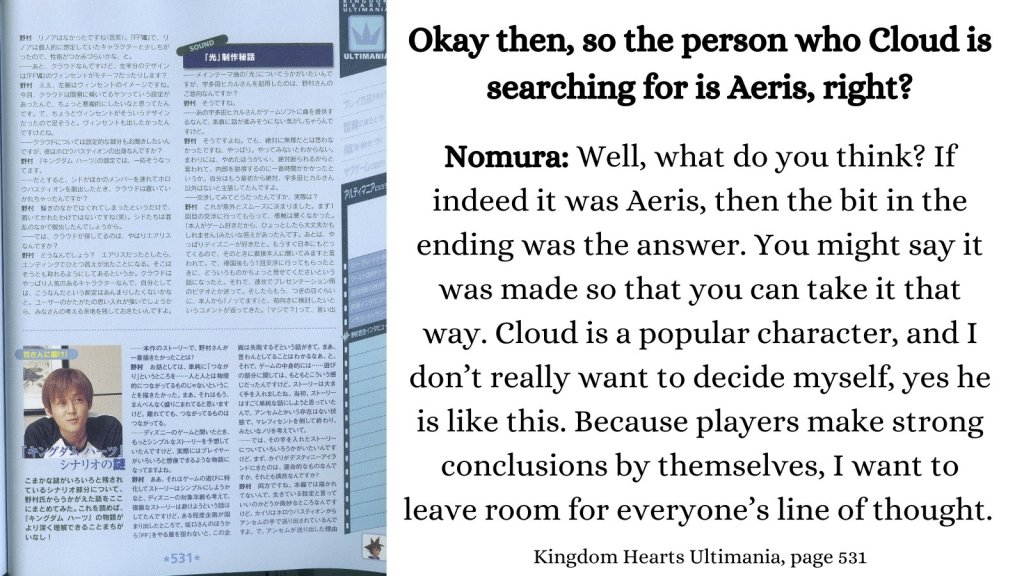
Not to pick exclusively on Cloti, Nomura hasn’t offered clarity on Clerith either. In the Kingdom Hearts Ultimania, Nomura expresses this same sentiment when asked if Cloud, in the Kingdom Hearts universe, is searching for Aeris. He gives a vague answer and then says:
Cloud is a popular character, and I don’t really want to decide myself, ‘yes, he is like this.’ Because players make strong conclusions by themselves, I want to leave room for everyone’s line of thought.
Nomura, Kingdom Hearts Ultimania, page 531
Have the other devs said anything about it? Final Fantasy VII Remake’s Co-director Motomu Toriyama had a similar answer.

The relationships between Cloud, Aerith, and Tifa were definitely ambiguous, even back in the original, so I wanted to make sure I kept those relationships – pushing the limits of what we can depict, while still looking like two people genuinely caring for each other and being natural.
FF7 Remake Co-director Motomu Toriyama, Inverse.com Interview
Let’s move on to Director Yoshinori Kitase!
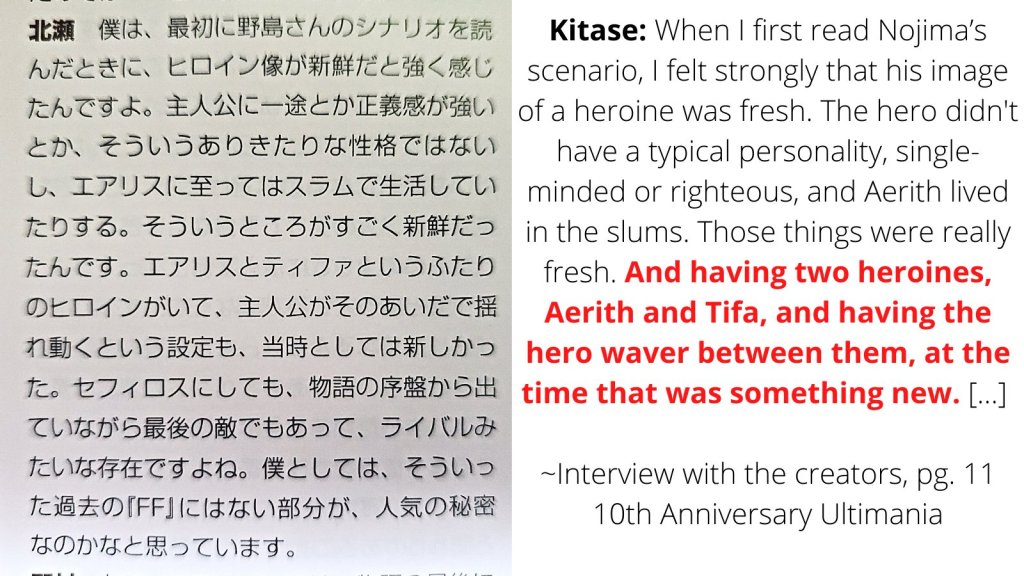
“Having two heroines, Aerith and Tifa, and having the hero waver between them, at the time that was something new.”
Yoshinori Kitase, 10th Anniversary Ultimania, page 11
Kitase makes clear that the core concept of Final Fantasy VII’s romance is ambiguity and the ability to let the player decide for themselves again in the Final Fantasy VIII Ultimania, where he compares the “affection points” mechanic to the straightforward love story of Squall and Rinoa. While they initially considered allowing Squall to romance multiple characters, Rinoa had “a special significance for the story they wanted to do.”
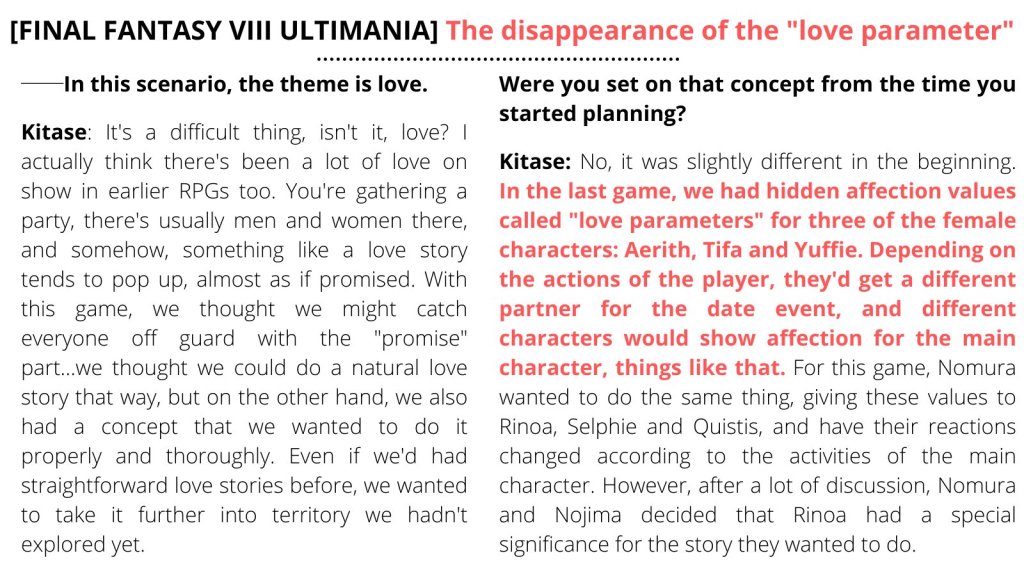
Kitase in FF8 Ultimania: “In the last game, we had hidden affection values called “love parameters” for three of the female characters: Aerith, Tifa and Yuffie. Depending on the actions of the player, they’d get a different partner for the date event, and different characters would show affection for the main character, things like that.
Kitase, Final Fantasy VIII Ultimania
Does Kitase think one romance is “canon”? If he does, he doesn’t show it, instead claiming that the devs never talk about relationships outside the game itself in an interview with Push.com:
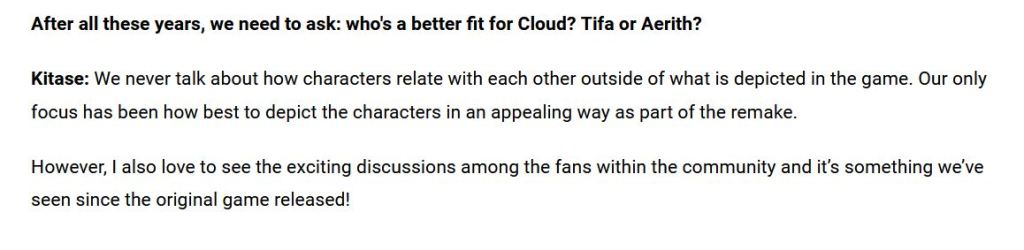
After all these years, we need to ask: who’s a better fit for Cloud? Tifa or Aerith?
Kitase: We never talk about how characters relate with each other outside of what is depicted in the game. Our only focus has been how best to depict the characters in an appealing way as part of the remake.
However, I also love to see the exciting discussions among the fans within the community and it’s something we’ve seen since the original game released!
Kitase, Push.com interview (May 24, 2020)
Now onto scenario writer Kazushige Nojima, who does an awful lot of the game’s writing and is responsible for Final Fantasy VII‘s novels, On the Way to a Smile, The Kids are Alright: A Turks Side Story, and Tale of Two Pasts.
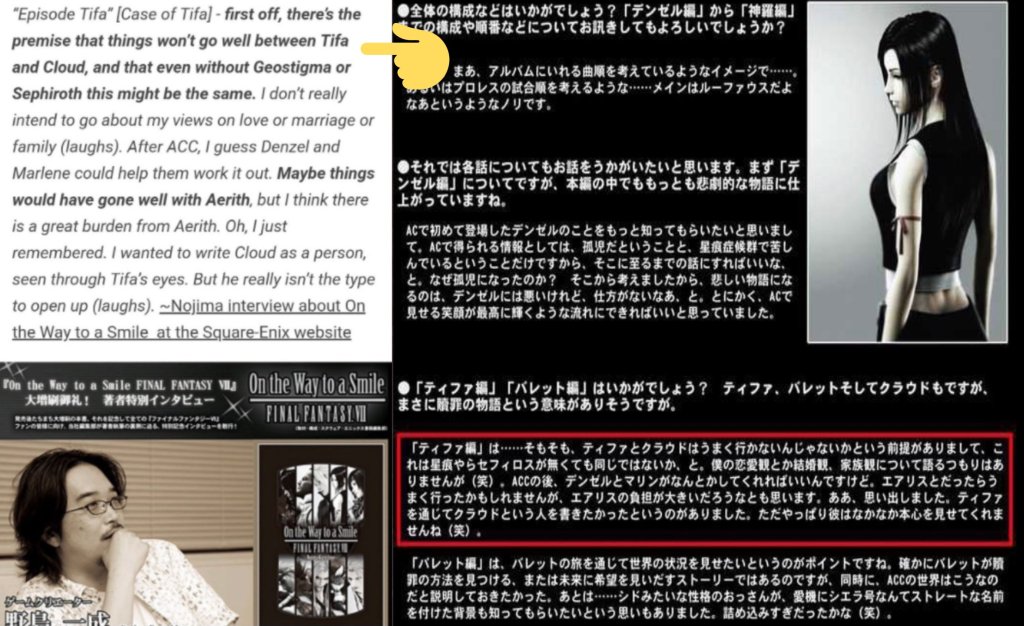
Discussing the “Case of Tifa” chapter of his official novel, On the Way to a Smile, Nojima ruminates on if Cloud and Tifa can and will ever work out.
“First off, there’s the premise that things won’t go well between Tifa and Cloud, and that even without Geostigma or Sephiroth this might be the same. I don’t really intend to go into my views on love or marriage or family. After ACC, I guess Denzel and Marlene could help them work it out. Maybe things would have gone well with Aerith…”
Nojima, Advent Children interview
Nojima flat-out says the problems between Cloud and Tifa would exist regardless of the movie’s chaotic drama with JENOVA and Sephiroth, and implies the issue is interpersonal. He muses if Denzel and Marlene can help them “work it out” before positing that things may have gone better if it were Aeris alive with Cloud.
So there we have it. The writers consistently say the love triangle is ambiguous, open-ended, and up for players to decide. Even after Aeris dies and Cloud is living with Tifa, it still isn’t canon that they are in a romantic relationship.
Shippers of all walks and paths, you do you.
 Earth & Sky: A Cloud x Aeris Love Story
3 thoughts on “What the Devs Say About Final Fantasy VII’s Love Triangle: It’s Open-Ended (duh!)”