
Final Fantasy VII Remake‘s soundtrack flaunted clever rearrangements and medleys of beloved tracks from the original game, but the game’s end credits theme song was something completely new. Legendary Final Fantasy composer Nobuo Uematsu returned to compose the piece, which featured vocals performed by Yosh of Survive Said The Prophet. FF7 lead writer Kazushige Nojima himself penned the Japanese lyrics, though the English translation is used for all language versions of the game. Uematsu and Nojima confirmed in an interview with Famitsu that:
- The lyrics are indeed meant to be from Cloud’s point of view (and singer Yosh was instructed to “sound like Cloud” while performing.)
- Tetsuya Nomura provided thematic concepts to Nojima when writing the lyrics, which included “Cloud’s point of view” and the concept of “standing in the rain”
- Nojima interpreted that as “a ballad for a man who lost something important to him” (Nojima uses the word 大切なもの as “something important – we’ll get to that)
- The original title of the song was 空っぽの雲 (Empty Clouds). Though this uses the Japanese word for “cloud” and not a transliteration of Cloud Strife’s name, the connection is intentional. “Empty” or “hollow” was the foundational theme for the piece.
It’s clear that Hollow has narrative importance, but what is it? This essay will explore the following:
- When We Hear Hollow: On when and how Hollow is used during the story
- Aeris: A Legacy of Death: Why Remake is about Aeris’s death even while she’s alive
- Underscoring Cloud’s Grief: On how Cloud’s grief for Aeris is emphasized
- A Lyrical Analysis: Diving into the lyrics and determining how they can only apply to Aeris
- Losing Something Important and Standing in the Rain: A pattern of describing Aeris as Cloud’s “important” person and what the image of Cloud “standing in the rain” might refer to
- Performances: On official performances of Hollow and the use of Aeris’s image
- Conclusion: Final thoughts
In Hollow, Cloud is singing to someone he lost, which are too intimate to refer to some intangible concept like “sense of self” or “past memories.” This is someone he wants to “embrace”, whose “smiling face” he yearns to see. While he wants a do-over, (“Smile bright once more, this time, I’ll never let you go”) he laments that this person is no longer with him (“I know that you’re long gone.”)
Who is important to Cloud that is conspicuously gone? Could it be his mother – a minor but meaningful presence in the Nibelheim flashback scenario? Could it be Zack – his best friend who unwittingly provided much of the framework for his false persona? Or is it the game’s lead heroine, a secondary lead in Final Fantasy VII Remake whose iconic death surpasses the Final Fantasy series’ own fame and is commonly cited as one of the most shocking deaths in video game history?
If the answer isn’t already clear, let’s look at more deeply Hollow and its presence in Final Fantasy VII Remake.
When We Hear Hollow
As the game’s official theme song, Hollow begins playing in the last handful of seconds of the game’s ending, with the bulk of it playing throughout the ending credits. The first notes of the song play right after a scene of Cloud and Aeris standing next to one another.
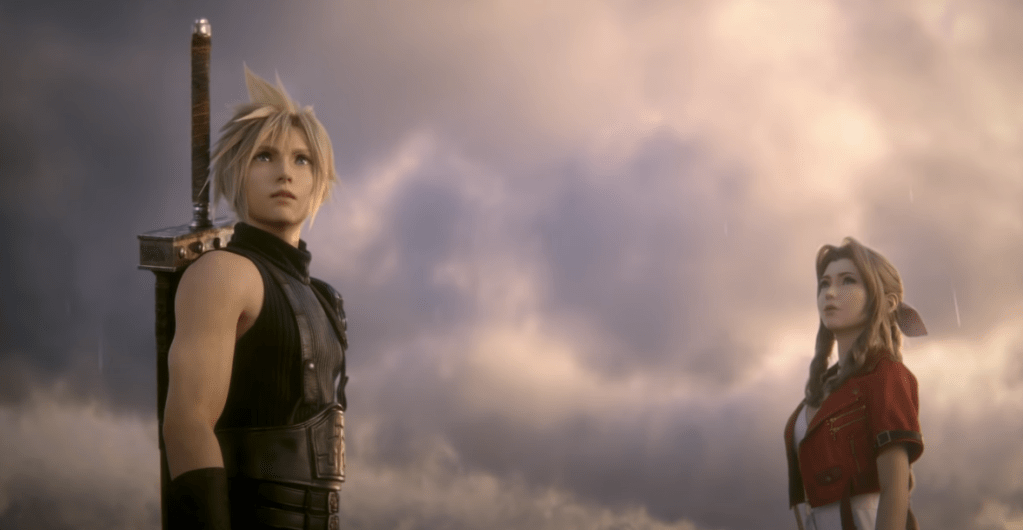
Next, we see what seems to be an alternate timeline of Zack, rewritten to survive his fate at the hands of Shinra soldiers, carrying a semi-conscious Cloud toward Midgar. The camera emphasizes Aeris, suggesting that she may have sensed this strange scene, which notably deviates from the original game’s events. As the camera pans to her alone, she then utters the final line of dialogue in the game, which directly precedes the opening lyrics of Hollow:
English: I miss it. The steel sky.
Aerith, Final Fantasy VII Remake ending
Japanese: 空…嫌いだな (trans. “The sky…I hate it.”)
Aeris’s remark might seem random and mysterious, but there are two suggestions as to what it might mean.
One, that the open sky represents the great unknown of freedom from the fate they have just dismantled. Midgar’s steel ceiling was complacency for a known end, but now, with nothing hanging above their heads (including, perhaps, her own sword of Damocles), anything could happen. For Aeris, who seems to know the future – and her own infamous demise – this freedom seems to leave her conflicted. Will things be better now? Will, like she warns Cloud in Chapter 18, the group not only change the future, but change themselves as well?
Aerith: This is the point of no return. Destiny’s crossroads.
Chapter 18
Cloud: Then why did you stop me?
Aerith: I’m not really sure.
Tifa: What will we find on the other side?
Aerith: Freedom. Boundless, terrifying freedom. Like a great, never-ending sky.
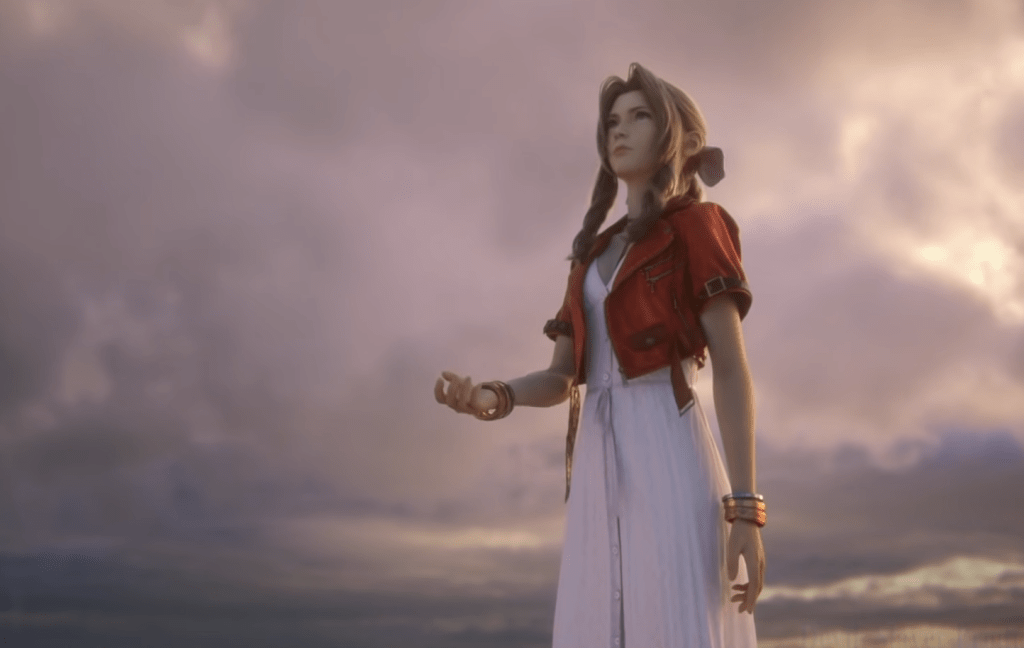
The second meaning that the sky holds to Aeris is unveiled in an interview with Tetsuya Nomura, who reveals it represents to her an amalgamation of death, Shinra, and JENOVA.
The sky sort of symbolizes sadness for Aerith. Zack and her mother were both taken away to the sky, the sky above the slums is covered by Shinra, and the calamity that destroyed the Ancients, Jenova, also came from the sky. Knowing all of that, Aerith prefers the artificial steel sky.
Nomura, Final Fantasy VII Remake Ultimania
As the final words spoken in the game, her line must have been chosen intentionally. Its connection to the theme song of Hollow is therefore impossible to dismiss.
But this is not the only time we hear the theme song’s melody. An instrumental version of the song is titled Hollow Skies – which was, incidentally, the original title of the main theme as well. This name makes it even more likely that Aeris’s line about the sky was carefully chosen. But where is it that Hollow Skies plays?
In the Sector 5 slums – Aeris’s hometown.
Notably, it does not play from the moment Cloud and Aeris enter the slums, but rather, it begins to play the moment Aeris briefly separates from Cloud, leaving him to explore town alone. We hear the song again later in the game: after the Sector 7 Plate falls, Cloud rushes to Elmyra to debrief upon Aeris’s capture, and after this meeting, Hollow Skies will once again play in the Sector 5 slums.
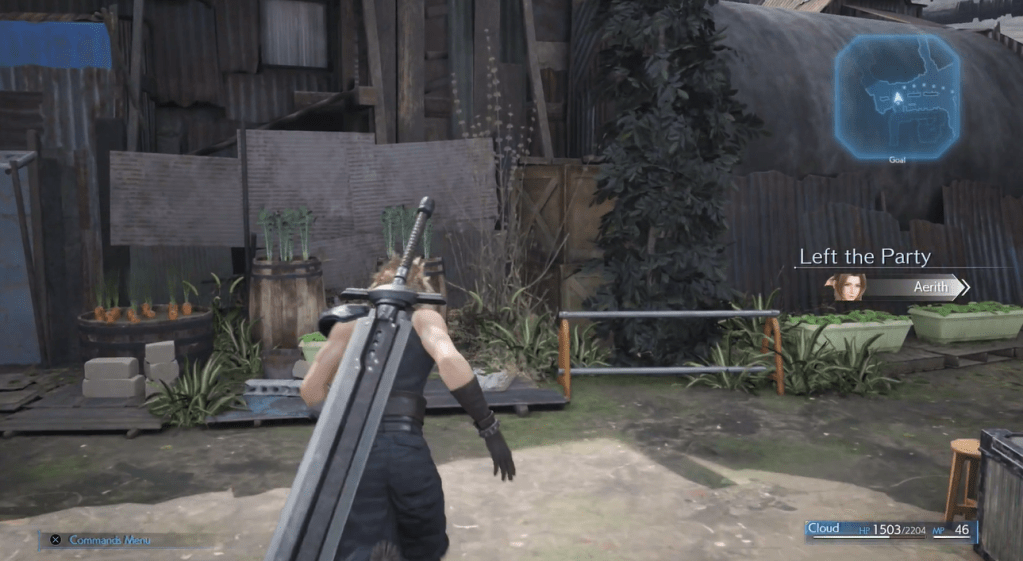
With that, it seems like the song is essentially Aeris’s theme song – yet we know Hollow‘s lyrics come from Cloud’s point of view. It follows that the lyrics are about Aeris. Hollow Skies is cued to start at moments in Sector 5 when Aeris is conspicuously separated from Cloud – so Cloud singing about her being “gone” is a clever parallel.
As a song about a man who “lost something important” – could it really be about Aeris, even while she is still alive?
Aeris: A Legacy of Death
Aeris is ostensibly alive in Final Fantasy VII Remake, which has led some to dismiss the possibility that Cloud could be singing a song about mourning her – and counter that the only meaningful person to Cloud that is deceased is Zack. (No one seems to seriously argue that the theme song could be about Cloud’s mother, or some other unnamed neighbor that perished in the flames of Nibelheim.)
It’s true that Final Fantasy VII Remake covers events in the story prior to Aeris’s murder by Sephiroth’s sword – but the game, which adds an important new elements of fate, future, and foresight – is centered around her inevitable death.
Cloud meets Aeris first after the Sector 1 bombing on Loveless Street. As he wanders the post-attack destruction of the streets, the song The Promised Land is heard – a theme which was not present in the original Final Fantasy VII but rather was introduced in the sequel film Advent Children, and plays when Cloud senses Aeris’s soothing presence after the movie’s climax.
When he meets Aeris, he is quickly interrupted by a vision of Sephiroth ominously placing a hand on her shoulder and telling Cloud that he cannot protect anyone.
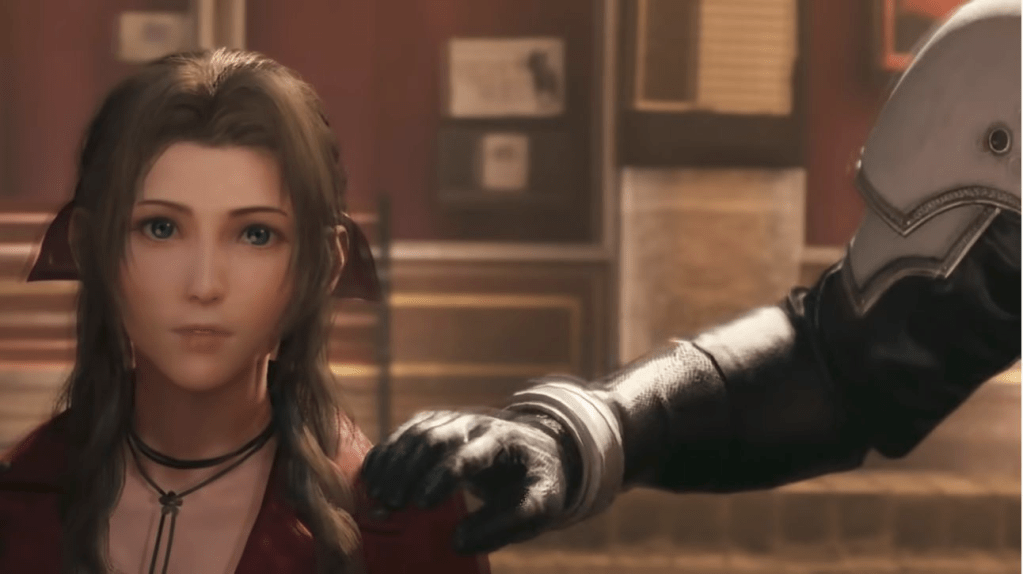
Any player familiar with the original story will gasp. It is Sephiroth who murders Aeris, after all. His presence is unexpected, a departure from the original game’s narrative. Sephiroth mocking him about Aeris’s death – which, in the future, will haunt Cloud terribly – is as eerie as it is incredible.
But subsequent hints of Aeris’s fate are less subtle yet. In Remake, Cloud sees visions of the future, including Aeris’s infamous death scene at multiple moments throughout the story. Each time, he clutches his head and we hear static interference, like he is remembering something that has not happened yet. Cloud has these visions:

- Chapter 8: When reuniting with Aerith in the Sector 5 church upon Aeris mentioning she keeps a materia in her hair ribbon, he sees Aeris praying at the altar and her materia falling (which, in the original game, happens when Sephiroth stabs her.)
- Chapter 9: When Aeris begins to walk away from him in Sector 6, he sees a vision correlating with the sight of her leaving him in the Sleeping Forest, in the dream she said her farewell to him in the original game. This vision causes a tear to fall down Cloud’s cheek, meaning consciously or not, he felt the emotional weight of her death.
- Chapter 16: When watching Shinra’s pro-Lifestream propaganda video in Shinra HQ, the footage is suddenly corrupted. He sees Aeris praying at the altar (as well as Meteor destroying Midgar.)
- In Chapter 18: When the team fights the Whisper Harbinger boss, they each see disturbing images of the future as ordained by fate. Cloud sees the previous vision of Aeris praying at the altar and her materia falling.
- Chapter 18: The very final vision that Cloud sees before the Whisper Harbinger is destroyed is another vision of Aeris’s death. This time, he sees himself laying her to rest in the lake of the Forgotten City.
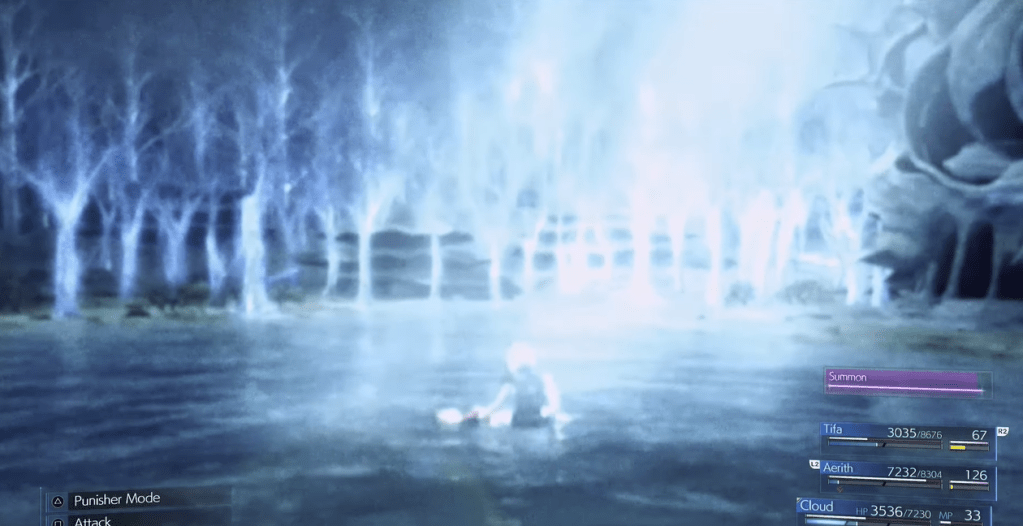
Aeris herself seems to have foresight into the events of the original game. The Whispers, supernatural keepers of fate that seem to operate on an imperative to ensure the events of Remake follow those in the original game, continually haunt her. Rather than give her this uncanny knowledge, Aeris claims they are trying to take it away:
Aerith: Every time the Whispers touch me… I lose something. A part of myself.
Chapter 17
Knowing that Aeris has at least some awareness of the future, lines like this are especially meaningful.
Aerith: Everyone dies eventually.
Chapter 14
Cloud: I suppose.
Aerith: So we need to make the most of the time we have—to live our lives the way we wanna live. Every minute…every moment, matters.
Cloud: I’ll remember that.
Aerith: Good. So…
Cloud: You need to embrace this moment. Right?
Aerith: I’m glad I met you, Cloud. I really am. I’m grateful for all the words we’ve shared. For all the moments and the memories. You’ve made me more happy than you know. And I’ll always cherish what you’ve given me. But… But whatever happens, you can’t fall in love with me. Even if you think you have…it’s not real.
Cloud: Do I get a say in all this?
Aerith: It’s almost morning. Time to go.
Cloud: I’m coming for you.
Aerith: If that’s what you want. Thank you.
This exchange, which also appears to Cloud in what seems to be a dream, alludes to Aeris’s own death and offers important context to Aeris’s motives in trying to dissuade Cloud from falling in love with her.
Final Fantasy VII Remake‘s main antagonist isn’t President Shinra – it’s Fate, which in turn sets up a mystery involving the game’s head villain, Sephiroth. Among all these visions of “tomorrow if we fail here today” (as Red XIII’s posits), chief among them is none other than Aeris’s death.
Conversely, if the object of Cloud’s grief is meant to be Zack, then Zack’s lack of presence in the game until the final moments of the ending is peculiar. Though Zack’s existence looms in the details – for instance, obscured but obvious to Final Fantasy VII veterans in Aeris’s line of questioning toward Zack in Evergreen Park, or evident in certain Shinra soldiers’ recognition of the Buster Sword. But ultimately, this stays on the outskirts of the story – there is no emotional flashback to Zack’s death, no moments spent offered to Cloud to mourn the friend he doesn’t remember. Only Aeris’s death is treated as of thematic importance.
Underscoring Cloud’s Grief
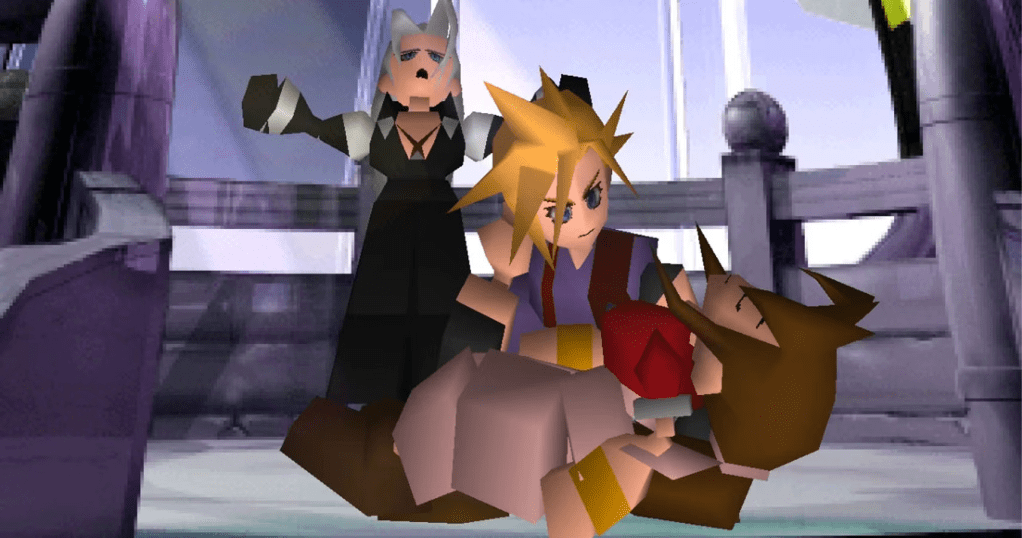
Cloud’s immediate anguish and long-term bereavement at losing Aeris is one of the most eminent aspects of his character and legacy as a Final Fantasy protagonist. Her murder before his eyes stuns him, and as he tries to put words to his pain, he narrates what has become one of the game’s most famous quotes.
Aeris is gone.
Cloud Strife
Aeris will no longer talk, no longer laugh, cry…… or get
angry……
What about us…… what are WE supposed to do?
What about my pain?
My fingers are tingling. My mouth is dry. My eyes are burning!”
Indeed, Square Enix recognized this as one of the game’s most iconic lines and scenes at their 15th anniversary event, and has been voted by fans as one of the game’s heaviest-hitting lines of dialogue.
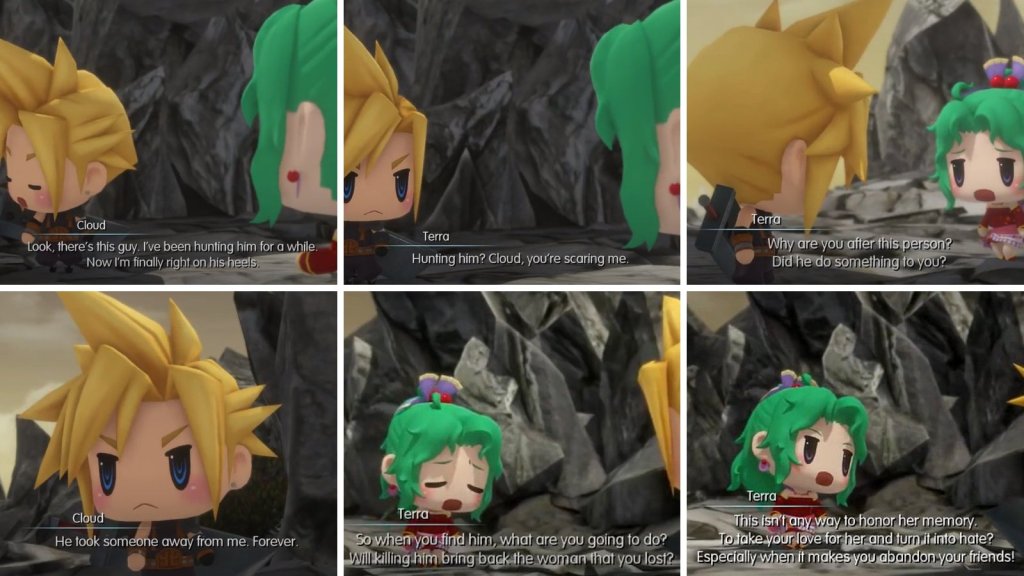
Cloud has made an array of cameos in spin-offs and other games throughout his 25-year tenure. Frequently, he is portrayed as “a man who lost something important” – from Final Fantasy Tactics, where he seems to be plucked from his own world after Aeris’s death, or World of Final Fantasy, where he seeks revenge against Sephiroth for taking “the woman he loves.”
In 2018, while Remake was well in development, Square Enix held an official Final Fantasy 30th Anniversary exhibition in Tokyo centered around the theme “Farewell,” which explored the grief of their main characters – many of whom have experienced great loss. For the Final Fantasy VII portion, Cloud and Aerith were featured, and as perhaps the most famous episode of loss, they headlined the event in promotions and in an extensive exhibit at the venue itself.

A tagline for the event was, あなたがもう一度、会いたい人は誰ですか。(“Who is the person you want to meet once again?”) Though Zack was mentioned in the event booklet as one of the people Cloud lost, the actual exhibition focused on Aeris. That is, the one Cloud wants to meet again is Aeris.

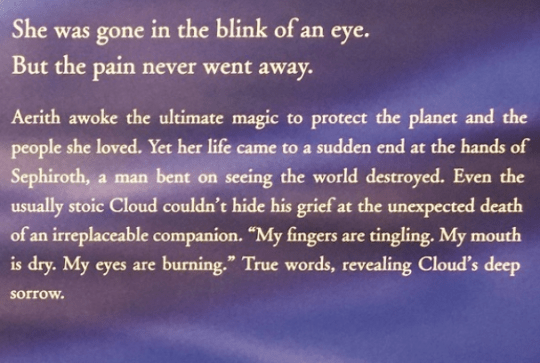
The event included an exhibit of Cloud laying Aeris to rest, which detailed his heart-wrenching pain at the “loss of an irreplaceable companion.” Cloud’s featured quote from the event was none other than: “My fingers are tingling. My mouth is dry. My eyes are burning!” The exhibit also stated, “She was gone in the blink of an eye. But the pain never went away.”
The event also included a recreation of Aeris’s flowerbed and church in the Sector 5 slums with an audio performance of “Words Left Behind by Aerith,” a monologue penned by Nojima. This monologue was the first instance of the mascot character Stamp being referenced, which means it incorporated new lore into its composition. Likewise, Hollow may have been written or even recorded by this time. Nojima, after all, wrote the lyrics both to Aeris’s monologue and to Hollow.
Cloud’s pain at Aeris’s death is a major part of his character in the post-OG Compilation materials. In On the Way to a Smile, Cloud tries – and fails – to lead a normal life, ultimately falling back into mourning. In Advent Children, Cloud’s geostigma is essentially a metaphor for his own depression. His inner turmoil over loss and grief found the conflicts of the film.
Thus, Cloud’s grief – in particular, for Aeris – is intrinsic to the legacy of his character.
A Lyrical Analysis
| Japanese | English |
|---|---|
| 漂い 流れて | I would be lost, drifting along |
| 迷った 時でも | Floating up high, time after time |
| あなたの輝く | And there you’d be shining brightly |
| 笑顔が導く | Your smiling face to guide my way |
| 傷つき倒れて | Bloody and bruised, brought to my knees |
| 打ちひしがれても | When beaten down, when broken up |
| あなたに触れたら | You would appear, Reach out to me, |
| すべては癒され | Heal every wound, and make me whole |
| 浮かれてた? そうかもな | Was it all a dream? Will I never know? |
| 何も 知らずに | Foolish and blind to everything |
| 気づくのが 早ければ | Had I realized, had I thought it through, |
| 抱きしめられたかい? | Would you be here in my embrace? |
| もう一度 輝け | Shine bright once more |
| 一度でいい 見つけるから | Guide me to you |
| もう一度 笑って | Smile bright once more |
| 今度は 離しはしない | This time, I will never let you go |
| 笑顔には 隠された | With your every smile hiding something more: |
| 秘密が あったね | Dark mysteries lurking beneath |
| でき俺は 空っぽで | But I was consumed with this emptiness |
| 求めて ばかりで | This selfishness, this void to fill |
| もう一度 頼むよ | Hear me once more |
| 笑顔を見せて | Show me your smile |
| もう一度 今度こそ | This time for sure |
| 涙の跡に 気づいてみせる | I’ll see the truth hidden inside your tears |
| ああ わかるよ | But I, I know |
| あなたは いない | That you’re long gone |
| でも 俺は | But I, I will |
| 叫び続ける | Go on |
| 空っぽだから | Howling and hollow |
If Final Fantasy VII: Remake is about Aeris’s death, and Hollow is from Cloud’s point of view, in what way can the lyrics be applied to their relationship? The words in the song not only do fit the point of view of a future Cloud who has lost Aeris, she is the only character that can fit.
Let’s look at each verse.
I would be lost
Drifting along
Floating up high
Time after time
And there you’d be
Shining brightly
Your smiling face
To guide my way
Cloud describes feeling lost and adrift, but cites someone with a “smiling face” who “shines brightly” and “guides” him. Aeris is known for her bright personality, and is almost always smiling – even when she herself is in pain. As Cloud himself notes, Aeris was “smiling to the end.”

She guides him literally several times whilst alive. First, she starts to lead him rather immediately after contracting him as her body guard. First, she leads him to her house, then she again acts as his guide en route to Sector 7. When he hesitates upon seeing Tifa heading to Wallmarket, Aeris leads him to her rescue.

In fact, Aeris is officially cited as having a グイグイ引っ張っていく personality – someone who leads around others without hesitation, someone who pulls you to where they want you to go.

But it isn’t only in life that Aeris guides Cloud. After her death, she continues to watch over Cloud from the Lifestream. After Cloud fights Sephiroth in the Northern Crater at the end of the game, Aeris extends her hand to him and guides him out of the Lifestream and to safety.
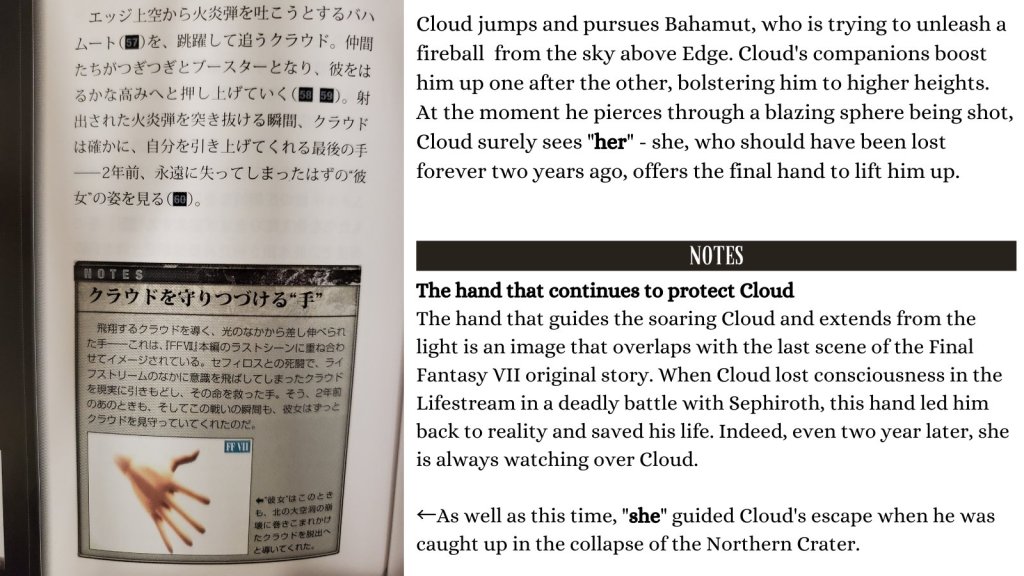
In Advent Children, Aeris acts as a spiritual guide to Cloud. Cloud, who has lost himself to despair and depression, grieves the loss of Aeris. She appears to him in visions, encouraging him to forgive himself. When a grieving Cloud tells her he wants to be forgiven more than anything, she laughs and smiles as she teasingly asks, “By who?”

Bloody and bruised
Brought to my knees
When beaten down, when broken up
You would appear,
Reach out to me,
Heal every wound,
And make me whole
Cloud next describes someone who heals him when he is hurt. While someone like Zack might have suited the previous verse about a smiling face who guides him, Zack is no healer, and there is no precedent for him habitually healing Cloud. On the flip side, Aeris is a white mage with healing abilities. It may be a little on the nose, but with her first Limit Break called “Healing Wind,” Aeris is the first character any player would think of when asked about healers.
But her role as a healer extends beyond battle. She has a calming presence and helps him ground himself when swept away by hallucinations.

In Advent Children, she continues to heal him even after her death. First, she heals Cloud and Tifa both after they passed out in the church following the fight with Loz. Secondly, Aeris heals Cloud’s geostigma, a disease thought to have been fatal, preceding Cloud’s fight with Kadaj. Finally, when Cloud is attacked by Loz and Yazoo at the film’s end, and briefly wakes up alongside the phantoms of Aeris and Zack in an afterlife-like realm, Aeris sends him back to the world of the living, where he awakes inside her church.
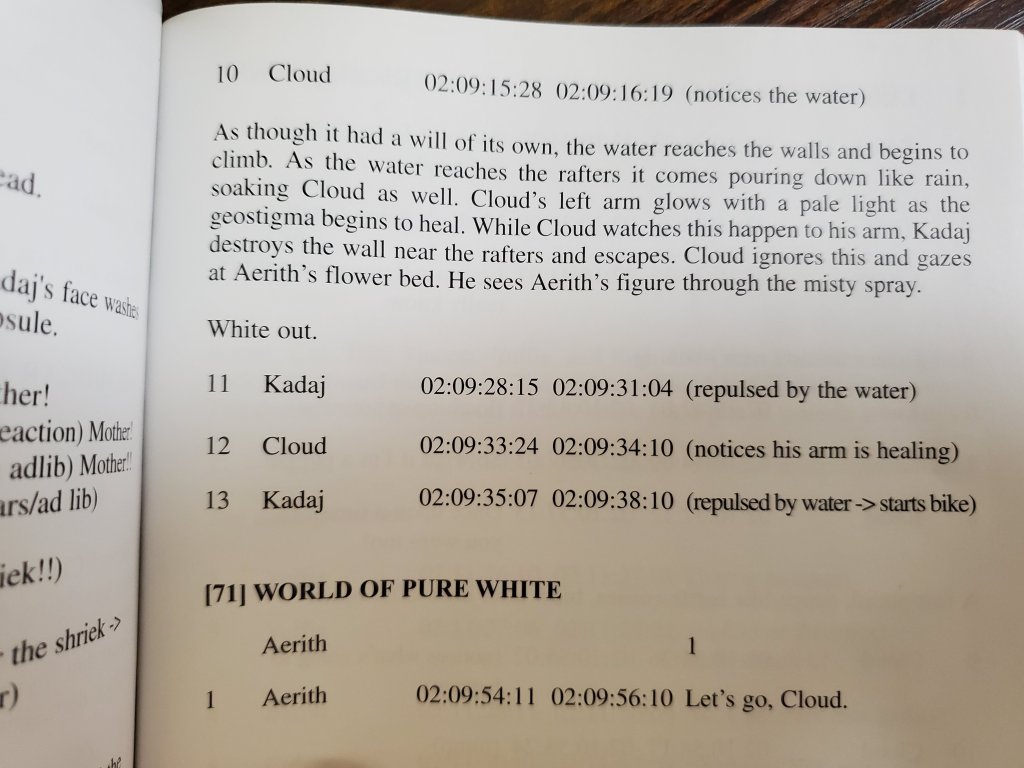
Perhaps more severely than even the geostigma, Cloud, who blames himself for Aeris’s death and grieves the loss of both her ad Zack, is suffering from depression. Aeris’s role in helping Cloud forgive himself and move on is probably her most poignant act of healing yet.
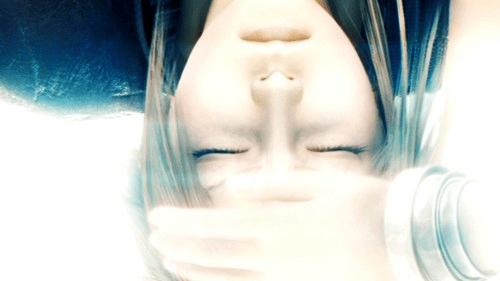
Was it all a dream?
Will I never know?
Foolish and blind
To everything
Had I realized,
Had I thought it through,
Would you be here in my embrace?
Cloud invokes the idea of a dream of this person, and not knowing if it were real or not. One interpretation might be less literal – that after this person’s death, they felt as far away as a dream. In Aeris’s case, however, this line is not metaphorical. Cloud has several dreams throughout the Compilation – and most are about Aeris.
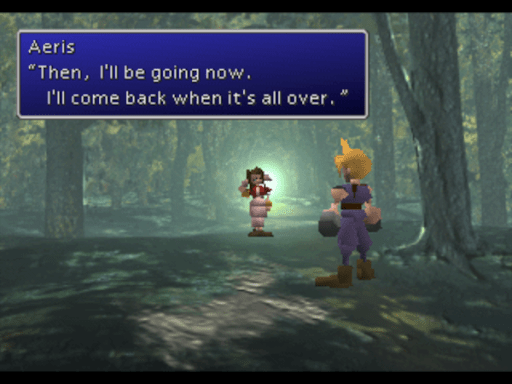

In the original game, Cloud dreams of Aeris’s good-bye to him, and her promise to “come back when it’s all over.” Sephiroth infiltrates the dream, threatening her life to Cloud, who then tries in vain to run after her. (This fraction of the scene is the vision Cloud sees in Remake’s Chapter 9).
In Advent Children, Cloud has dream-like visions of Aeris, who seems to be maintaining a real presence as a spirit in the Lifestream. For Cloud, standing in a mystical field of flowers with the woman he loved and lost, a lyric meditating on the reality of these spiritual encounters also applies.
In Final Fantasy VII Remake, Cloud has another dreamlike encounter with Aeris. In Chapter 14, Aeris has been captured by Shinra, and Cloud, Barret, and Tifa resolve to save her. In the middle of the night, however, Cloud sees Aeris appear in the gardens outside her house – or at least, a phantom of Aeris.
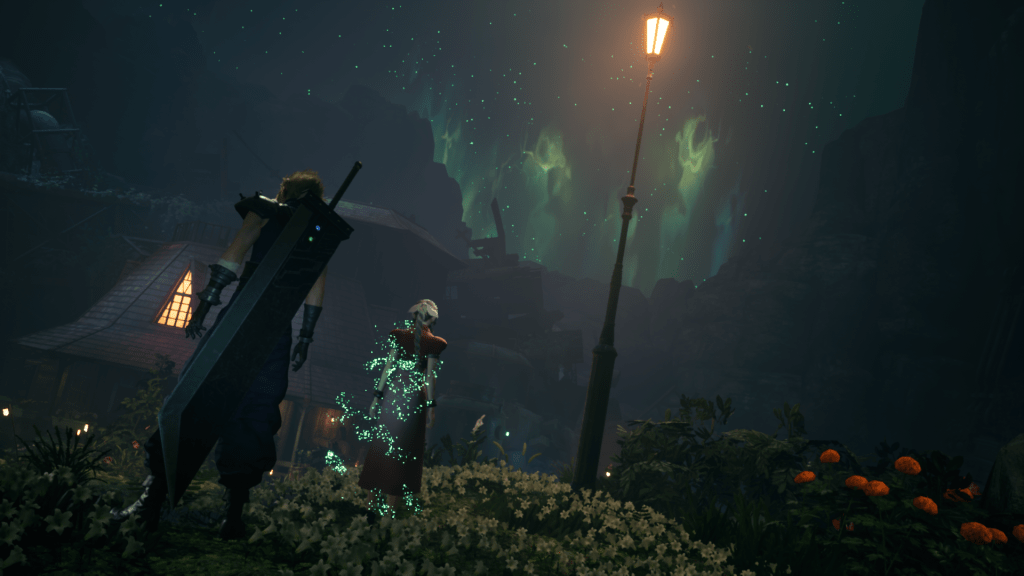
In this tender scene, Aeris alludes to the inevitability of her own death and asks Cloud not to fall in love with her. Cloud objects, and states his intention to save her. This Aeris, by the way, has been cited by writer Toriyama to be a “memory of the distant future” (Final Fantasy VII Remake Material Ultimania Plus.) That implies that the Aeris Cloud meets in his dream might not literally be the present-day Aeris he met in Chapters 8 and 9, but rather a reflection from Aeris’s future – who knows her fate, and her love for Cloud. It makes this encounter even more mysterious. Cloud must wonder if it’s only a dream, or if he was really visited by a phantom of Aeris that night.
In the second half of this verse, Cloud admonishes himself, claiming that he didn’t realize something important and wonders if he had “figured it out” if this person would still be here, “in his embrace.” Of course, we know there is one character whom he blames himself for failing, and that’s Aeris.
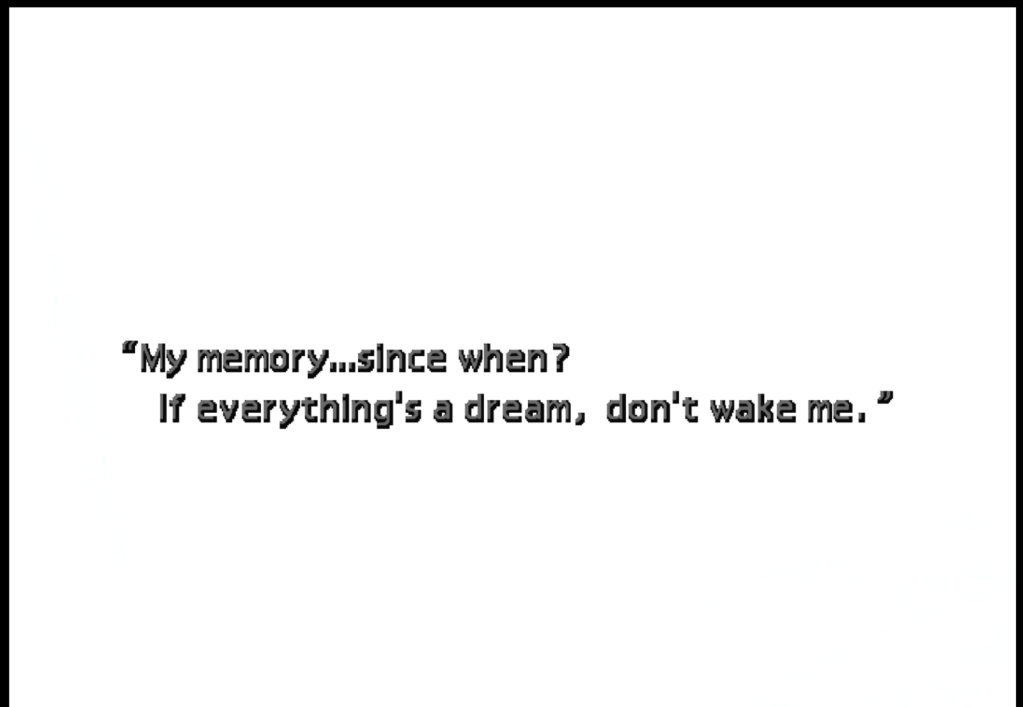
In the original game, his dream of Aeris’s farewell follows a harrowing scene where Cloud is controlled by JENOVA and forced to give Sephiroth the black materia. Whether still controlled by JENOVA or in a psychotic episode within his own mind, Cloud beats Aeris in an uncontrollable fit. This moment perhaps solidifies Aeris’s decision to leave the party and go to the Temple of the Ancients on her own, saying her farewell to Cloud in a dream.
In reality, Cloud was shocked that Aeris left the party and is overwhelmed with grief. Why did she leave? Could he have stopped her, if he had confronted the truth about himself he denied himself from accepting – that JENOVA and Sephiroth took advantage of?
While she cheered Cloud on and let him lead their journey, in in reality, Aeris had another agenda: to discover more about her Cetra heritage and her duty as the last remaining Ancient. There are a few occasions where she lets Cloud in on the anxieties about what it means to be a Cetra, and the loneliness she carries as a result – for instance, in Costa del Sol, or in Cosmo Canyon.

Cloud tries to comfort Aeris here, and even suggests he wants to be there for her. But he doesn’t push the issue, and lets Aeris ponder the things she has learned about protecting the Planet and her Cetra duty.
By the time of the Temple of the Ancients, Aeris is able to commune with the Planet and what’s left of the Temple’s Cetra spiritual guardians. Likely, she discovered here that she must pray for Holy. Perhaps she would have directed Cloud to the Forgotten City as her bodyguard, if not for his weakness giving into JENOVA.

Later in the game, after Aeris’s death, Cloud revisits the Forgotten City and discovers that Aeris has successfully activated Holy. It’s only then that he realizes what her plan was. He apologizes to her for not figuring it out sooner – perfectly reflecting Hollow‘s lyrics.
Shine bright / Once more
Guide me / To you
Smile bright / Once more
This time / I will never let you go
While these chorus lyrics don’t offer any new hints at the object of Cloud’s lamentation, they double down on a few we have already discussed – such as someone who “shines bright” and who “guides.”
More interestingly, Cloud is revealed to be asking for another chance. His request that this person shine “once more” implies a wish for this deceased person to return. He also vows that this time, he will never let that person go.
Who was it that left him? Of course, Aeris.
With your every smile
Hiding something more
Dark mysteries
Lurking beneath
But I was consumed
With this emptiness
This selfishness,
This void to fill
Cloud next describes that this person was carrying dark secrets and pain behind their smile, which he did not notice because he was obsessed with his own problems.
At this point, there is little question if the person he is talking about is Aeris. Substituting his mother or Zack makes no sense – the lyrics are too intimate to be about his mom, and Zack, who speaks his mind, hides nothing from anyone and puts words to his hurt.
On the other hand, Aeris – who is known for smiling – hides her Cetra heritage, hides that Shinra is after her, hides that her painful loneliness, and hides that she plans to leave the party to pray for Holy alone.
In Remake, her “dark mysteries” multiply, as she now knows the future. Even when the other characters ask her point blank what she is not telling them, she only shakes her head or changes the topic. Whether it’s uncanny knowledge about Cloud being a mercenary, or Sephiroth’s return, or the inevitability of the Plate falling – or worse – Aeris lets no one in on the harrowing knowledge.
To be clear, Aeris’s fatal flaw – literally – is her inability to let others in and share the burdens she shoulders.
If he wants to save her, Cloud must unravel her “dark mysteries” and pay attention to the subtle messages behind her words. But Cloud, in the original game, is obsessed with his own goals – first, to confront Sephiroth, without even wondering why. Consumed with an obsession over his failures and a desire to be a hero, he ignores his own reality, embracing a false persona representing fabricated successes.
Hear me once more
Show me your smile
This time for sure
I’ll see the truth hidden inside your tears
This lyric echoes the previous. Again, Cloud asks for another chance, vowing to see the “truth hidden inside [the] tears” of the song’s subject.
In English, this invokes his conversation with Aeris in Cosmo Canyon, where she mourns her duty as the sole surviving Cetra. The Japanese version of the lyric is 涙の跡に 気づいてみせる, which means,”I’ll see the traces of your tears” – which again, speaks to Aeris’s flaw of hiding her pain.

But I, I know
That you’re long gone
But I, I will
Go on
Howling and hollow
The final lyric confirms that the person he is asking for a do-over with is indeed dead. This means that if Cloud is singing, then it can’t be the present-day Cloud in Final Fantasy VII Remake – but rather, a Cloud from the future who is mourning.
Losing Something Important and Standing in the Rain
Let’s look back at the interview on the meaning of Hollow, where Cloud is interpreted by Nojima as as someone who has lost “something important.” The phrase here in Japanese is 大切なもの (taisetsu na mono) – which can mean a precious or cherished thing or person. A person-only variation, 大切な人 (taisetsu na hito) means “special someone” or even “significant other.” These phrases are regularly used to describe Cloud’s relationship to Aeris.
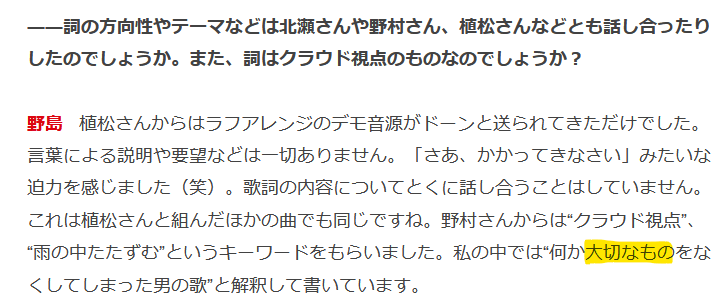
First, in the original game, Cait Sith delivers a fortune to Cloud, which reads “you will find what you’re looking for, but you will lose (your taisetsu na mono).” In this case, of course, the phrase refers to Aeris, who will die.
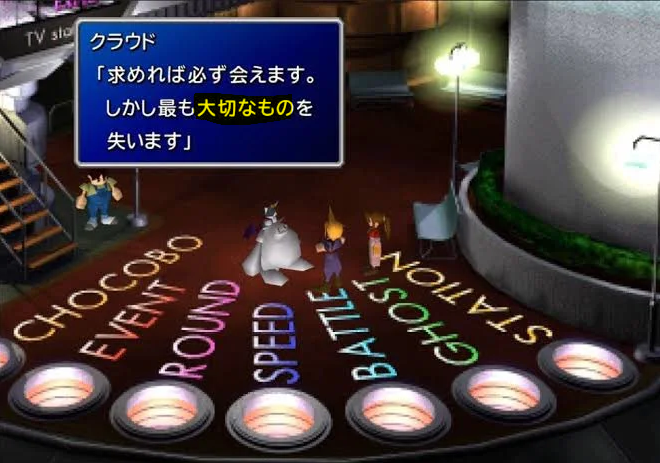
The examples of this throughout the Compilation and supporting materials are numerous. To list only a handful for brevity’s sake, Ultimania guidebooks describe Aeris as Cloud’s 大切な人. In World of Final Fantasy, 大切な人 is also used. 大切なもの is used, for example, in Record Keeper and Dissidia Final Fantasy. In Final Fantasy Tactics, Cloud warps to Ivalice and meets an alternate universe version of Aeris, and mourns that he lost a 大切なもの.
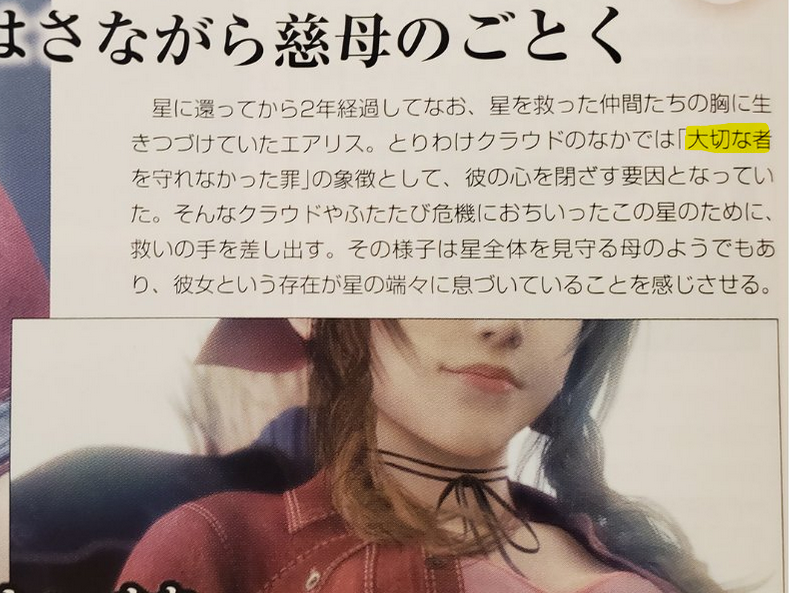
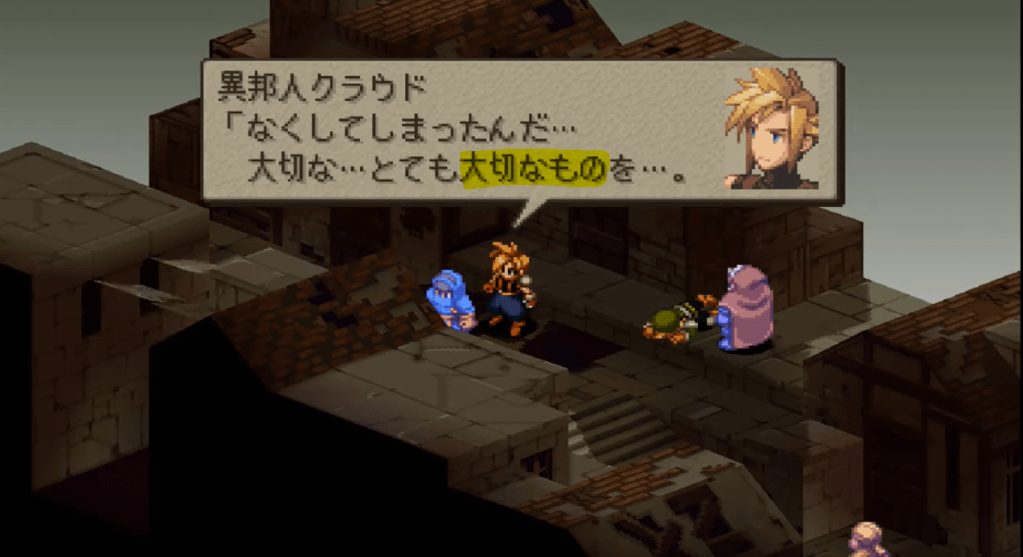
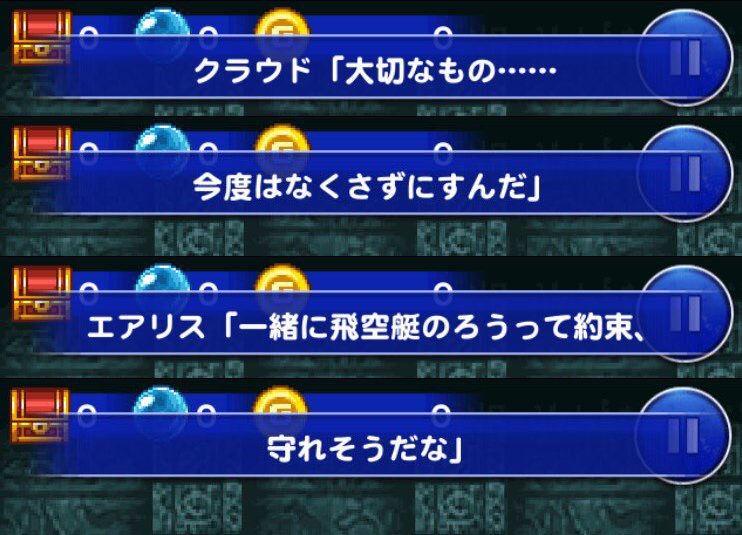
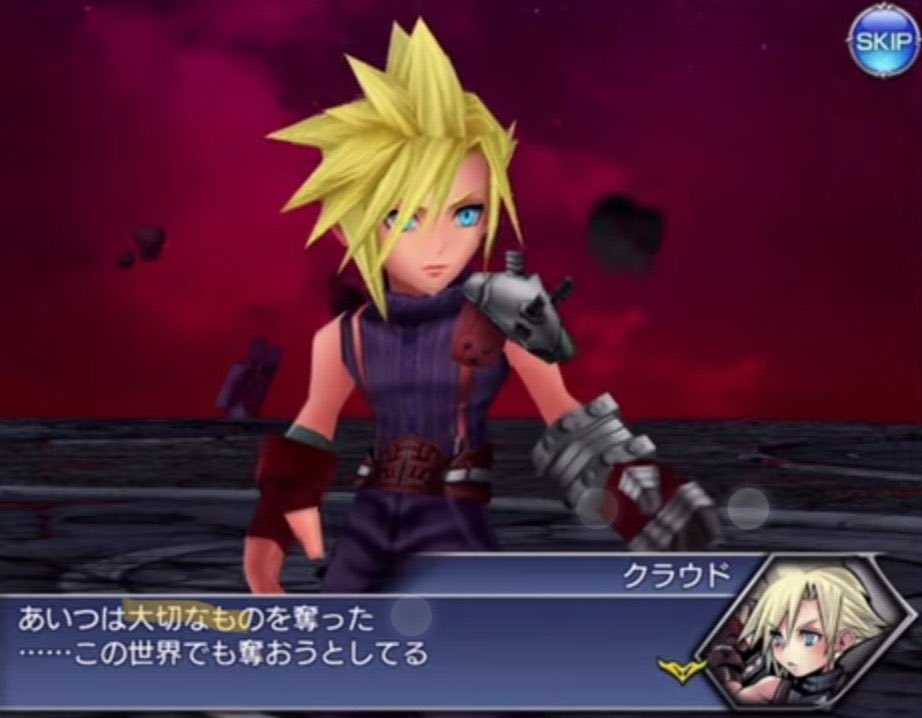
The established pattern of using the “taisetsu na” adjective to describe Aeris’s value to Cloud highly suggests that Nojima is describing Aeris at the object of Cloud’s loss.
Nomura provided a few keywords and phrases to build upon for Hollow, which included a description of Cloud standing in the rain in a barren place. A memorable scene in Advent Children is Cloud, upon defeating Kadaj, standing in a Lifestream rain and sensing Aeris’s presence. (At this moment, The Promised Land begins to play – the song that is used in Remake to set up Cloud’s first meeting with Aeris, but was not in the original game itself.)
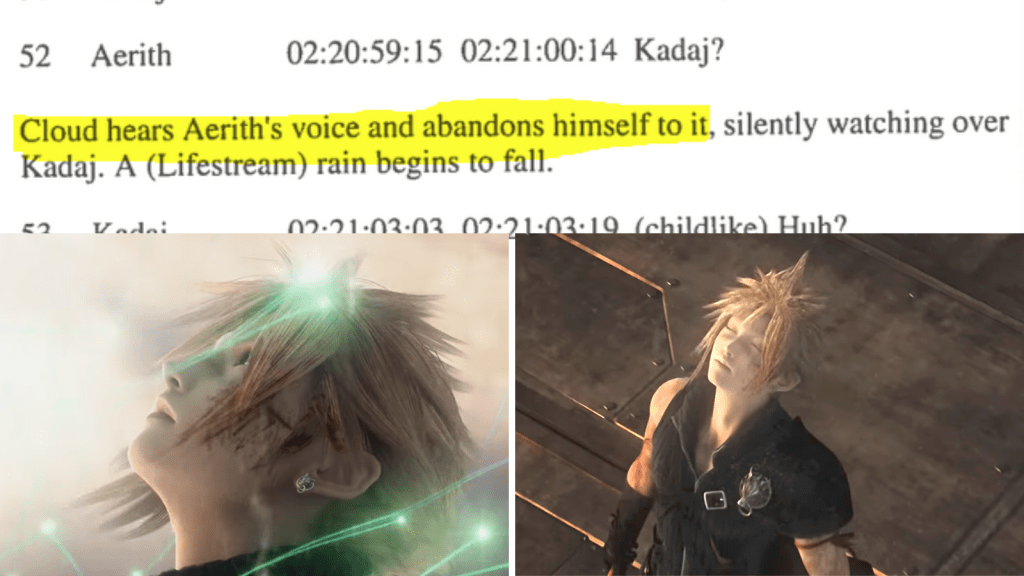
In fact, in Advent Children, Aeris is represented by rain. This is visually evident when at one moment, Tifa sees a raindrop, and in sensing Aeris’s spirit within it, thanks her for being there with them. Water is used to symbolize healing several times in Advent Children, often in the form of raindrops – healing Geostigma from Cloud and the children. That “water” represents Aeris is not speculation, as Nojima confirms the theory:
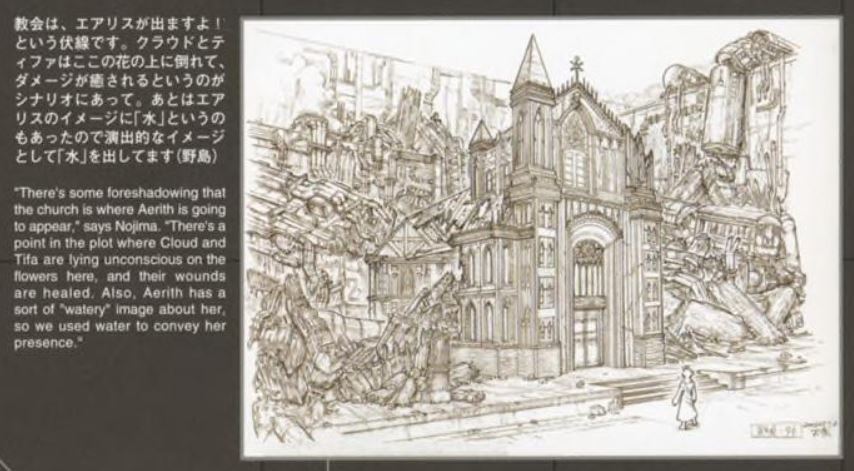
[…] Also, Aerith has a sort of ‘watery’ image about her, so we used water to convey her presence.
Advent Children Reunion Files, page 70
But in Remake, we also see Cloud standing in the rain – next to Aeris, in the very final moments of the game, and seconds before Hollow begins to play. Cloud and Aeris have another conversation in the rain in an extended ending follow the DLC Intermission.
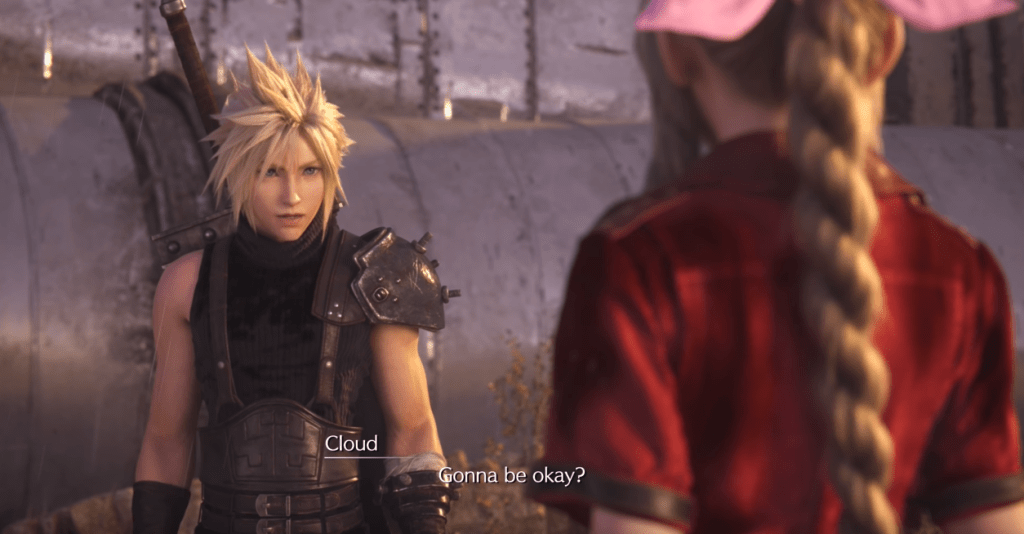
In other words, the ending song’s theme of Cloud standing in the rain is visually realized in the ending, and in both endings, the secondary focus in on Aeris.
Finally, in the aforementioned Final Fantasy 30th Anniversary: “Farewell” exhibit, a monologue titled “Words Left by Aerith,” also penned by Nojima, directly attributes rain to her death. In a section likely addressing Cloud himself, Aeris says:
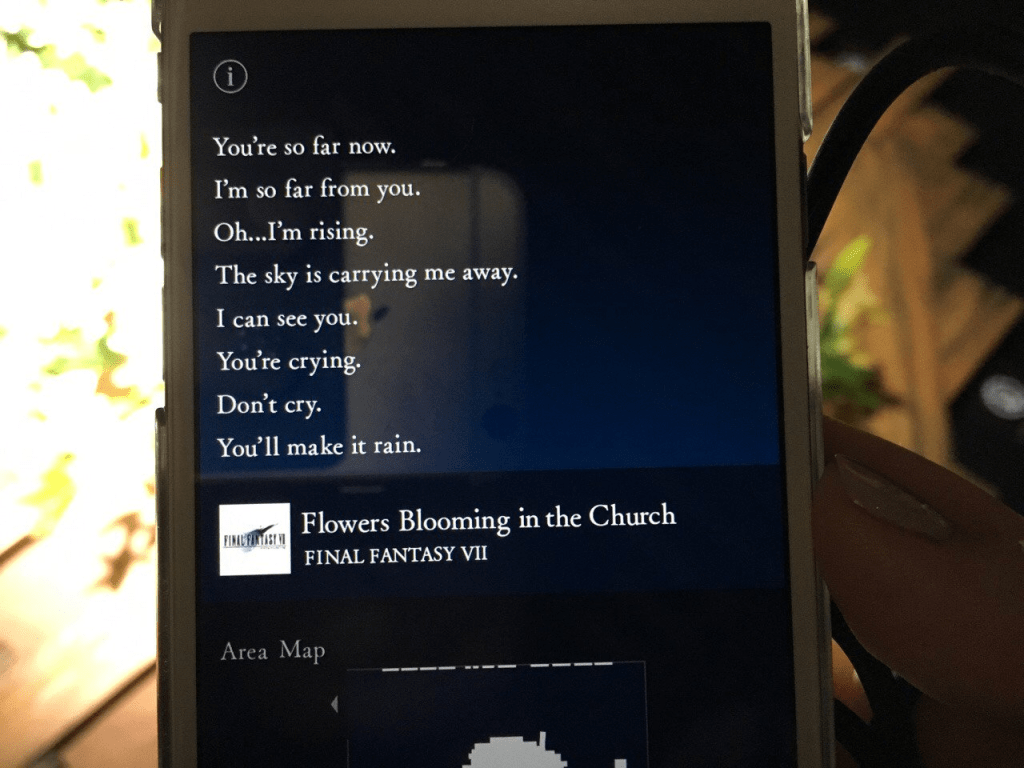
You’re so far now.
Words Left By Aerith
I’m so far from you.
Oh… I’m rising.
The sky is carrying me away.
I can see you.
You’re crying.
Don’t cry.
You’ll make it rain.
Aeris asking Cloud to stop crying upon her death because he will make it rain neatly ties together the concepts of Cloud’s grief at losing his “taisetsu na” person and standing in the rain.
Performances
Hollow has been featured as part of the official Distant Worlds orchestra tour. During the Remake concert, the song was performed with vocals. During the music, a video projector plays scenes from the game, specially curated to go with the music for the audience’s enjoyment.
While the 2021-22 Remake tour played a wide variety of scenes during the performance of Hollow, what is particularly interesting is that the footage ended on an extended scene of Aeris. In particular, the final moments of the song played to the image of Aeris communing with the Lifestream at the beginning of the game.

Conclusion
Hollow is the theme song to a game that embarks on the impossible challenge of recreating one of the world’s most beloved and nostalgic video games. Greatest among its narrative legacy is its mid-game murder of its heroine – a moment so shocking that its fame, at times, seemed even greater than the game itself. It seeped into popular culture, a reference as well known as Luke Skywalker’s parentage – no longer a spoiler, but a phenomenon absorbed loudly into gaming history.
To remake Final Fantasy VII is not to “remake” it. It’s to tell a story to an audience who inevitably already knows Aeris’s fate – even if they don’t yet know Aeris. No longer can her death be an unpredictable twist, so thus, the game takes a new direction: taunting the player with her fate while allowing Cloud already to mourn her loss – even before he knows she’s gone.
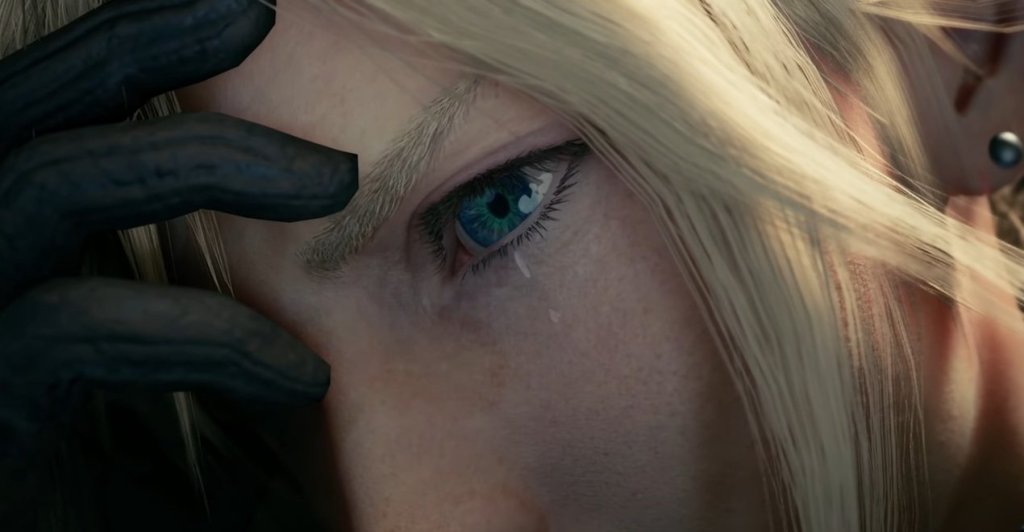
Ultimately, Hollow‘s subject being Aeris is obvious. A cursory read of the lyrics can only describe her.
But with the heavy-handed hints that Remake is not “a remake” but some kind of meta sequel to Final Fantasy VII, everything ties together. A future Cloud – perhaps one in Advent Children – mourns the death of Aeris, and asks for another chance. If Remake is set in an alternative timeline, Cloud may indeed get his second chance after all. This time, perhaps he can save her.
If not, then Cloud shall – in his own words – go on, even if he is “howling and hollow.”
 Earth & Sky: A Cloud x Aeris Love Story