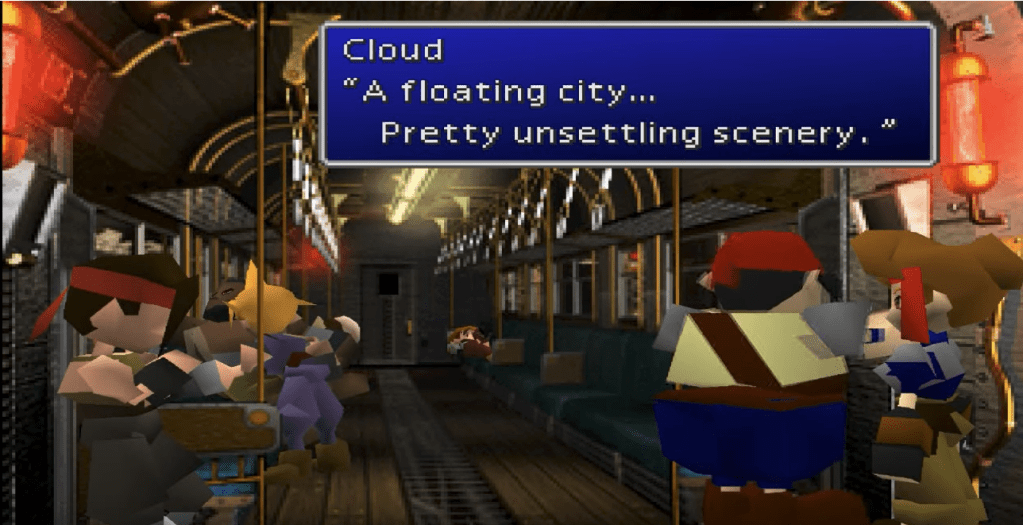
The cities of Final Fantasy VII operate somewhere within the aesthetic realm between cyberpunk and 80’s grunge. Sci-fi but not quite, we see a human population with flying airships but no successful human launch into space, chunky computers and PHS phones and a distinct lack of high-speed travel. While Final Fantasy VII: Remake injects a few new futuristic details, such as holograms and other imaginative new tech, the “garbage dump” elements remain as well – and for a purpose.
Nothing in the story better describes this “futuristic vs. grunge” contrast better than the game’s “Floating Cities” – metropolises build in the air that cast shadows (literally and extremely metaphorically) below. More than just a curious fantasy image, these floating cities are veritable open-heart surgery into the narrative foundation of the game itself.
Midgar, City of Mako

Final Fantasy VII’s Mako City of Midgar serves both as the game’s first dungeon, and the visual embodiment of the story’s central themes. Home to the first seven or eight hours of the game – and about a full third of the game’s dialogue – Midgar represents FF7’s central human and environmental conflicts: social inequity between the rich and poor, economic and militaristic subjugation by a fascist mega-corporation that has seized the crown of governance, ecological despair of a land drained of sunlight and nutrients, and the enslavement of the mystical and mysterious for scientific advancement (demonstrated by both the capture of the Cetra and JENOVA, and the harnessing of mako energy itself.)
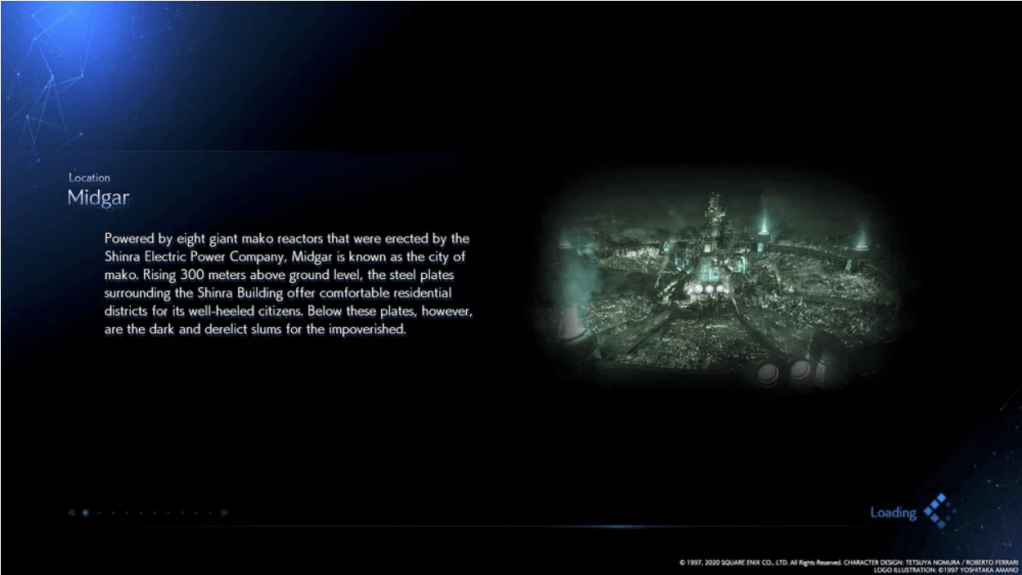
Powered by eight giant mako reactors that were erected by the Shinra Electric Power Company, Midgar is known as the city of mako. Rising 300 meters above ground level, the steel plates surrounding the Shinra Building offer comfortable residential districts for its well-heeled citizens. Below these plates, however, are the dark and derelict slums for the impoverished.
Final Fantasy VII Remake loading screen
The disparities in the world Shinra has designed isn’t only metaphorical. The visual of a beautiful city in the sky that hides its skeletons in the shadows underneath is perfectly literal: while the rich and chosen get to live on the plates above, the slums below are impoverished junkyards. In the center of it all is Shinra’s skyscraping headquarters, a corporate fortress that houses the company’s operations as well as its secrets: from a figure-head mayor to a laboratory run by a mad scientist personally responsible for most of the game’s monstrous atrocities. Surrounding the structure are the mako reactors that drain the Planet’s natural spiritual energy and burn it for electricity: as a result, the land both under the Plates and even surrounding Midgar is mostly barren, and the fumes have turned many of the animals into monsters.
Thus is our first – but not our last – City in the Sky: a technological triumph that elevates the privileged under the watchful eye of Shinra, while sweeping the garbage and undesirables underneath. When the land drains and dies, those on top are blissfully unaware, too high to see it. Those on the bottom can’t leave – whether because they can’t afford to, or because leaving the earth of their home is too painful a thought, no matter how dirty the air gets.
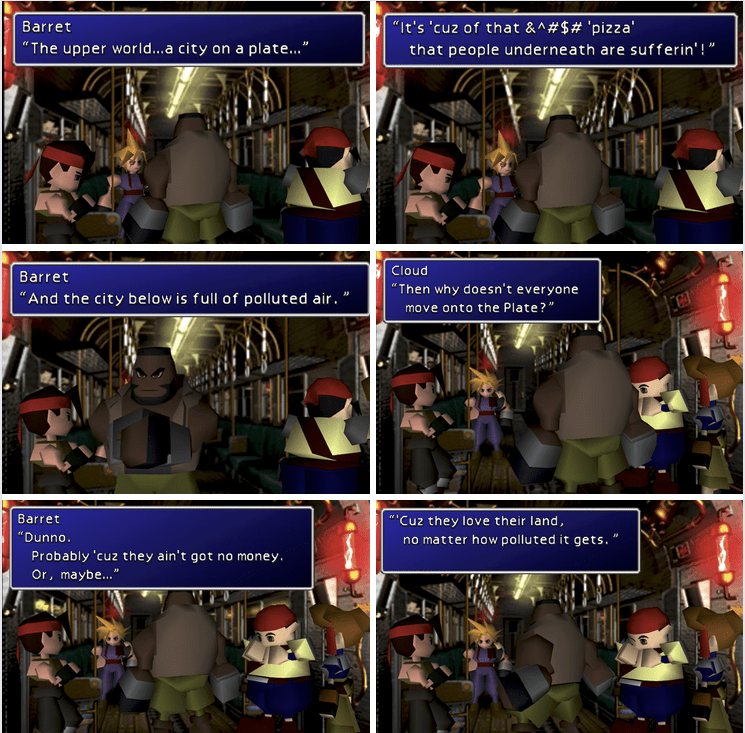
Barret
Look… you can see the surface now. This city don’t have no day or night.
If that plate weren’t there… we could see the sky.Cloud
A floating city… Pretty unsettling scenery.Barret
Huh?
Never expect ta hear that outta someone like you.
…you jes’ full of surprises.
The upper world… a city on a plate…
It’s ‘cuz of that &^#$# ‘pizza’, that people underneath are sufferin’!
And the city below is full of polluted air.
On topa that, the Reactor keeps drainin’ up all the energy.Cloud
Then why doesn’t everyone move onto the Plate?Barret
Dunno. Probably ‘cuz they ain’t got no money. Or, maybe…
‘Cuz they love their land, no matter how polluted it gets.Cloud
I know… no one lives in the slums because they want to.
It’s like this train. It can’t run anywhere except where its rails take it.
It’s then no surprise that the game’s intro sequence takes the camera around the city, before panning out and displaying the logo front and center. Midgar is, in many ways, Final Fantasy VII‘s most important visual.
But it is not the only city in the sky.
Junon, the Cannon City

After escaping Midgar, the party makes brief stops at a few small villages before arriving at the next major location: Junon, a military metropolis built around an enormous canon. Cloud can explore its multi-level neighborhoods by navigating an elevator, and traverse its towering edifices to shop and chat with locals – and do it dressed as a masked grunt-level soldier of Shinra himself. At the top of Junon, Shinra strives ever-higher: an airfield base houses the flying Highwind ship.
But to enter Junon-proper, Cloud must first navigate through Junon-real – a fishing village that lost its industry when the the construction of the underwater reactor that powers the elevated Junon poisoned the nearby waters of fish populations. Unable to access Upper Junon through the official elevator on his first visit, Cloud must wade into the dirty waters and rely on the help of a friendly dolphin – one of the few animals to come to the aid of the Planet’s protectors – and dodge high voltage live wires to climb up to the bed of this City in the Sky.
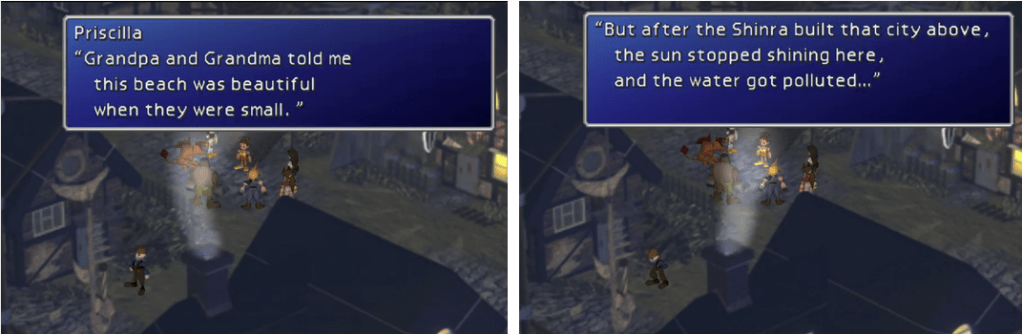
Junon serves as Shinra’s secondary base of operations after Midgar itself. During this city’s first visit, Cloud will wear his Shinra disguise and perform in a televised military parade and demonstration for Shinra’s President Rufus. A subsequent visit emphasizes its stark martial law even further: Barret and Tifa are captured and are to be publicly executed on live television. The military-worship of Junon is no surprise: the city is mostly populated by its enormous garrison and other noncivilian personnel residing in Shinra’s barracks. Even some of the residents are former military, with one elderly shopkeeper claiming he himself used to be a SOLDIER.
However, unlike Midgar, not even the privileged “up top” are free from economic struggles. As Cloud chats with locals, a reoccurring theme emerges of stagnant commerce for struggling small businesses. Shopkeepers are desperate to draw business – some relying on hiring cute girls to draw in visitors. A Shinra middle manager sleeps at a dingy hotel, expressing dismay at his company’s stinginess.
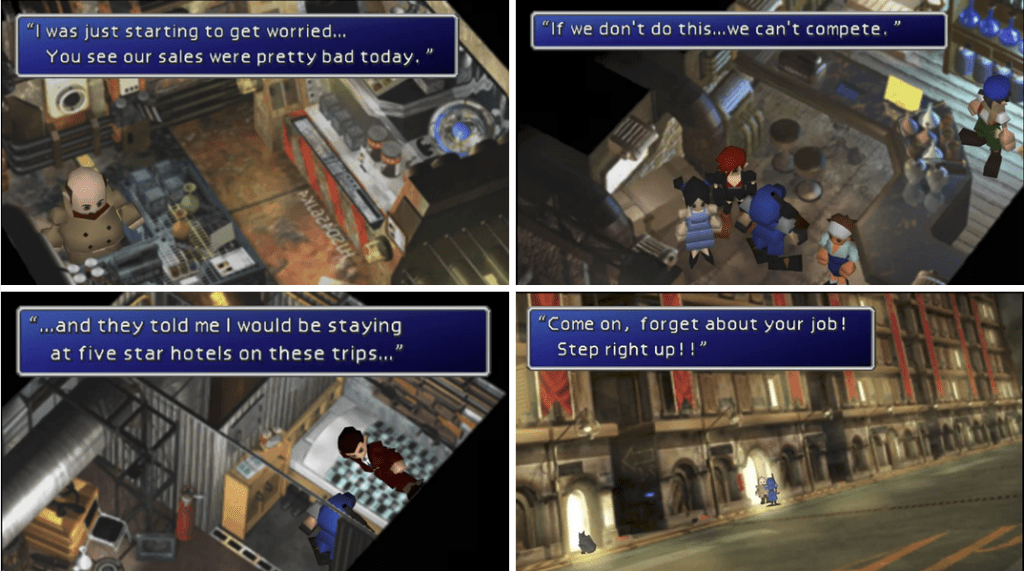
It seems that life “up top” is best when Shinra is literally your employer. Even the middle class is unable to compete with Shinra’s corporate reach, and any economic independence through non-Shinra industry is penalized.
Gold Saucer, the Sanctuary of Amusement

If Midgar is home of Shinra’s industry and Junon is Shinra’s military, then the Gold Saucer completes the trifecta as its entertainment district. The Gold Saucer is an amusement park and casino, built atop a tower and named for its seven branching “saucers,” or plate-like venues for various attractions such as chocobo-racing, arcades, a battle arena, and an on-site hotel. While entering the park costs a full 3,000 gil just for a single pass, here, visitors can’t pay for items or even for use of the Save Point in the normal-world currency, but must instead use an exclusive form of money called GP – technically prize points for winning games, but also purchasable through secret vendors, making the park literally pay-to-win.
If you have a guess what is underneath this floating amusement park, you’re probably right. The Gold Saucer “tree” was constructed above the now-ruined mining village of Corel – which, as Barret will tell you before your first visit to the park, is his hometown that was set ablaze and mowed down by Shinra. According to Barret’s story, the village mined for coal, which would have presumably been the world’s source of power before Shinra cultivated the use of mako energy. Shinra representatives convinced the residents of Corel to allow them to build a mako reactor, shutting down their mines in the name of being future-forward. However, the reactor had a defect and exploded in an accident, and rather than publicly admit their energy-sucking towers might be dangerous, Shinra decided to blame the residents of Corel and murdered them all in retaliation.
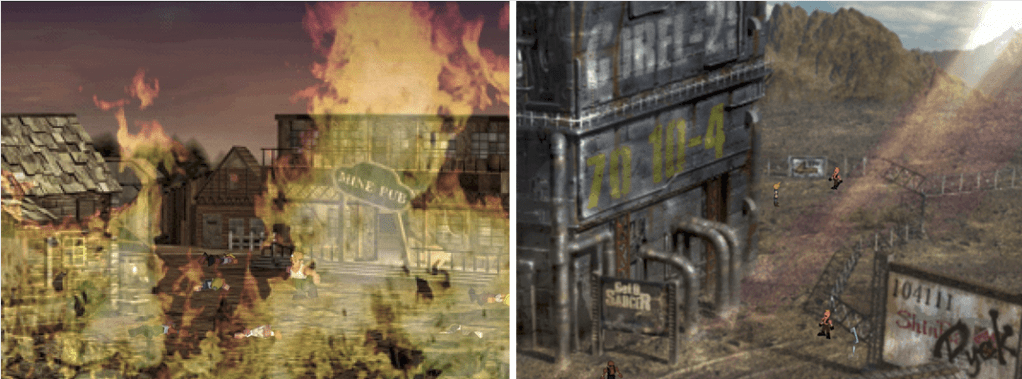
But Shinra’s devastation to the area is even deeper. Gold Saucer sits upon a literal wasteland, the ground presumably depleted of nutrients even more harshly than in Midgar itself. The ruins of the original village of Corel are now a desert prison, where Gold Saucer management literally ejects criminals below.
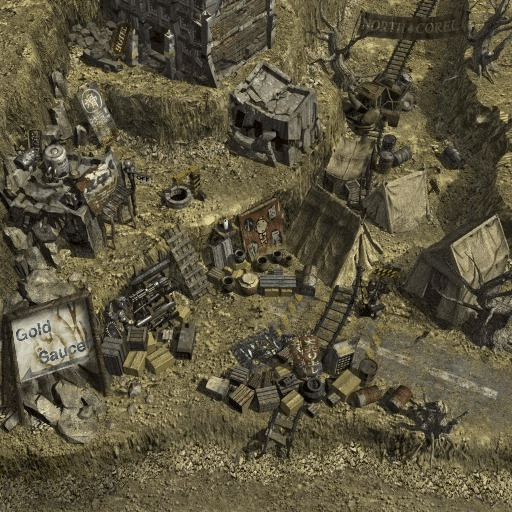
Now, the only way to visit Gold Saucer isn’t through the condemned Corel village, but via a ropeway from the nearby North Corel village. North Corel is – to no one’s surprise – also dirty and poverty-stricken. The miners (ex-miners?) reside in one of the most visually catastrophic areas on our entire world map – comparable if not worse than the slums of Midgar. Residents live in tents and rusty scrap metal on top of dried-out terrain. The aesthetic contrast between North Corel’s dingy sign pointing toward the ropeway station to Gold Saucer, and the indulgently flashy colors of the park itself, represent an incredible dichotomy.
Conclusion
While the Cities in the Sky provide a literal class divide between the privileged and the poor, they also represent Final Fantasy VII’s most significant theme: the exploitation of environmental destruction. When mako energy – which comes from the Planet’s own spiritual life force – is burned to advance the prosperity of (certain) humans, the earth suffers – something the players literally hear in the mourning “cries of the Planet.”
Shinra Corporation has instigated the Planet’s leeching, but even among the lesser privileged, many civilians surmise that life is still easier with the use of mako energy for electricity, just as many impoverished harbor their own patriotism toward their corporate overlords.

Their praise of Shinra adds some nuance to an otherwise comically evil business of villains. After all, many humans, even the poor, greatly benefit from access to affordable utilities and streamlined business, just as in a world of war and monsters, the protection of standing military can be a source of great comfort (even if Shinra was the one to create the wars and monsters in the first place.) But, convenient for humans or not, the blood that Shinra pumps isn’t a renewable resource, and the Planet is the price to pay for Shinra’s brand of fascism.
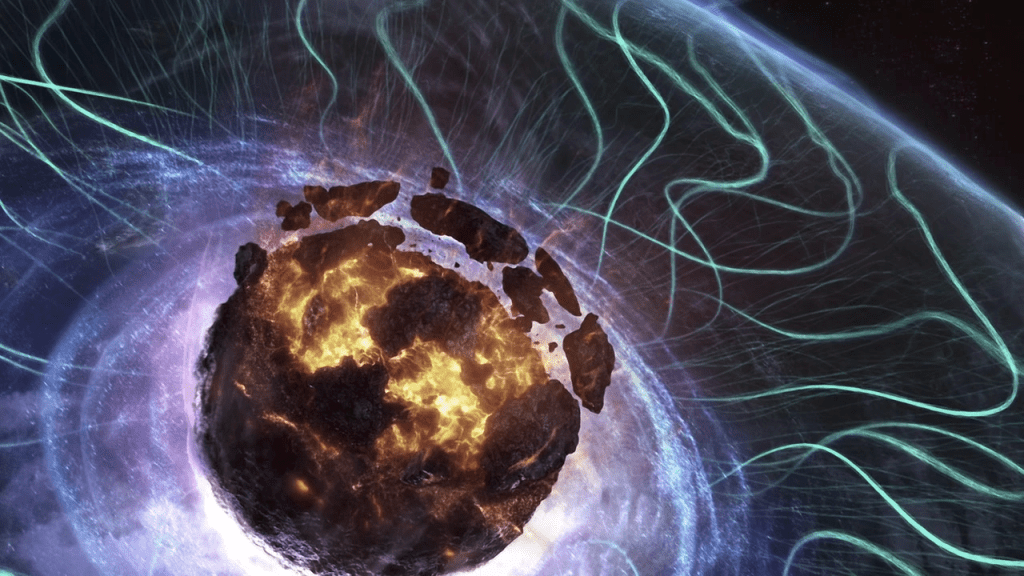
Sephiroth – Shinra’s ultimate creation – is, in many ways, only continuing the work of his founding patriarchs by aiming to personally suck up the Lifestream conjured from hurting the Planet. Except this time, Sephiroth means to look even higher than where Shinra’s Cities in the Sky float – and, by summoning Meteor, bring the sky itself crashing down on everyone.
 Earth & Sky: A Cloud x Aeris Love Story