The Final Fantasy 25th Memorial Ultimania, or the Final Fantasy Ultimania Archive (as it’s called in English), serves primarily as an art book. Released in 2012, the ambitious collection covers each mainline game in the Final Fantasy series for a quick story and character summary, as well as a collection of artwork created for each series (such as Tetsuya Nomura’s character sketches, concept art, and Yoshitaka Amano’s promotional artwork.)

As you might imagine, packing all of that material into one book is nigh on impossible, so the content is spread throughout three volumes, with Final Fantasy VII contained in the second. Fans in the West wouldn’t get their hands on this book until 2018, when Dark Horse Books translated and published the series as the “Final Fantasy Ultimania Archive” for the English-speaking world.
The result is.. not great. All right, it’s terrible.
To say the translator had a bit of a bias for Cloud/Tifa (“Cloti”) makes me sound like a bitter Clerith fan. But let me show you exactly what I mean.
My… ears are burning?

Japanese:
指先がチリチリする。口の中はカラカラだ。目の奥が熱いんだ!
True translation:
“My fingers are tingling. My mouth is dry. My eyes are burning!”
Dark Horse’s translation:
“My fingers are tingling. My mouth is dry. My ears are burning!”
Let’s start things off with a rather egregious typo – at least, I hope it’s just a typo. To say one’s ears are burning sounds as though they are embarrassed. To say one’s eyes are burning means they are about to cry. This line, which Cloud utters whilst cradling Aeris’s lifeless body, is considered among the game’s most iconic pieces of dialogue, and to muck up a line like that is cringe-worthy enough.
On Cloud and Tifa’s Promise Scene

Japanese:
「クラウドが有名になって、その時、私が困ってたら。。。クラウド、私を助けてに来てね」
ーティファの回想 (7年前):ソルジャーになる夢を語ったクラウドに約束させて
さほど親しいわけではなかったクラウドに、お姫様的な願望を何の気なしに託した13歳ティファ。幼い日のこの約束が、ふたりのその後に大きな影響を与えることに。
True translation:
“If you get really famous and I’m ever in a bind… you’ll come to save me, all right?”
-Tifa’s flashback (7 years ago): she makes Cloud promise her this after he shared his dream of becoming a SOLDIER
Though she wasn’t very close to him, 13-year-old Tifa casually entrusted Cloud with this princess-like wish. This promise they made when they were young would later have a large impact on both of them.
Dark Horse’s translation:
“If you get really famous and I’m ever in a bind… you’ll come to save me, all right?”
-During Tifa’s flashback to seven years ago, in which Cloud makes a promise to her before attempting to join SOLDIER
At the age of thirteen, Tifa casually asked her friend Cloud to commit to this vow. Their youthful promise has a great impact on their future lives.
Can you spot the differences? In Japanese, the text states that Cloud and Tifa are not close. Dark Horse dropped that fragment entirely and inserted the opposite meaning, referring to Cloud as Tifa’s “friend.” If you’ve played the game, you’ll know that the fact that Cloud and Tifa are not actually childhood friends is treated as a pretty significant twist.
Another little differences? In Japanese, the causative form is used when describing the promise: that is, Tifa made Cloud promise her. In English, it simply says Cloud promised her, eliminating the coercive meaning of the original.
On Cloud’s Chocobo Hair

Japanese:
髪のセットは欠かせません
トレードマークのツンツン立てた髪型は、 「チョコボ頭」と呼ばれもするが、 自分では お気に入りらしい。 別荘に一泊したときも、 まず最初に髪を整える。
True translation:
Styling his hair is essential
His trademark pointy hairstyle is sometimes called “Chocobo head”, but it seems to suit his fancy. Even when he stays the night at a villa, the first thing he does is fix his hair.
Dark Horse’s translation:
He Has the Look
Cloud’s distinctive pointy hair causes Tifa to tell him his hair looks like a chocobo. Despite the teasing, he really seems to like it. When staying in the villa, the first thing Cloud does is arrange his hair.
The original text does not mention Tifa at all. The Dark Horse translator chose to inject her name into this segment, saying Tifa is the one who teases Cloud (and Cloud seems to like it.)
Cloud invites Tifa on a date, but Aeris invites Cloud?

Japanese:
観覧車にてからまわる想い
みんなが寝静まった夜、 クラウドをデートに 誘うティファ。 もっとも、 奥手な性格ゆえに、 彼に面と向かって想いを伝えられず、思わせぶ りなことをつぶやくだけで終わってしまう。
True translation:
Thoughts Spinning Around A Ferris Wheel
While everyone is sleeping at night, Tifa invites Cloud out for a date. However, because she has a “late bloomer” personality, she is unable to express her feelings to him directly, and only ends up muttering hints to him.
Dark Horse’s translation:
Spinning Wheels on the Ferris Wheel
After everyone is asleep, Cloud invites Tifa on a date. She cannot bring herself to express her feelings face to face, and she ends the date with only the barest hint about wanting something more.
Our Dark Horse translator must not have liked that the text says Tifa invited Cloud out on a date, and so swapped who did the asking. Despite this blatantly not being what the Japanese says, nor what even happens at the Gold Saucer in Final Fantasy VII, the “translator” decided to put that Cloud was the one who asked Tifa, not vice versa, falsely suggesting Cloud took romantic initiative with her.
Meanwhile, look at the equivalent section for the Gold Saucer date with Aerith:

Japanese:
約束のデートは ゴールドソーサーで
「デート1回」の報酬を約束にはじまった、クラウドへ の護衛の依頼。ゴールドソーサーに泊まった夜、約束 どおり彼をデートに誘い、演劇をしたり観覧車に乗っ たり、つかの間とはいえ楽しい時間を過ごす。
True translation:
The Promised Date at the Gold Saucer
This the “one date” reward that [Aerith] promised Cloud when she asked him to be her bodyguard. During the night they stay at Gold Saucer, she invites him on this promised date. They participate in a play and ride the gondola, and while their time is brief, they have fun.
Dark Horse’s translation:
The Promised Date at the Gold Saucer
Aerith’s request for Cloud to become her bodyguard began with a promise that the two would share a date. During the night that the party spends at the Gold Saucer, Aerith invites Cloud for a night of fun, as promised. They act in a play, ride a Ferris wheel, and forget their troubles for the briefest of moments.
I wouldn’t say the translation here is particularly objectionable, but note that the Dark Horse translator has posited that while Aeris asked Cloud out for their date, in the case of Tifa, Cloud was the one doing the asking.
A True Wish Revealed: A tragedy in tenses
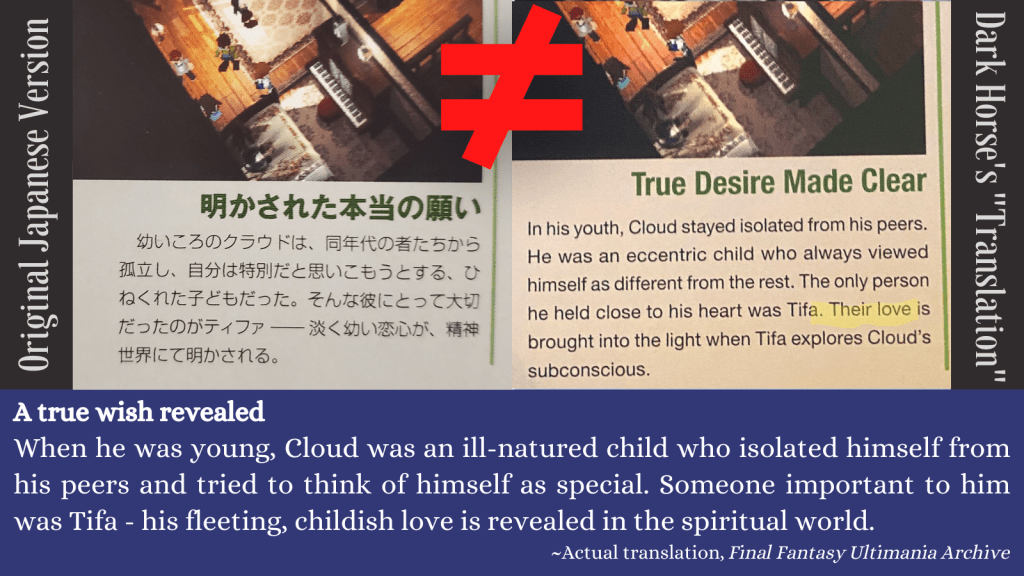
Japanese:
明かされた本当の願い
幼いころのクラウドは、同年代の者たちから孤立し、自分は特別だと思いこもうとする、ひねくれた子どもだった。そんな彼にとって大切だったのがティファ——淡く幼い恋心が、 精神世界にて明かされる。
True translation:
A true wish revealed
When he was young, Cloud was an ill-natured child who isolated himself from his peers and tried to think of himself as special. Someone important to him was Tifa – his fleeting, childish love is revealed in the spiritual world.
Dark Horse’s translation:
True Desire Made Clear
In his youth, Cloud stayed isolated from his peers. He was an eccentric child who always viewed himself as different from the rest. The only person he held close to his heart was Tifa. Their love is brought into the light when Tifa explores Cloud’s subconscious.
This one is perhaps the most horrifically objectionable of all. Again, the translator invented meaning that was not there in the original Japanese text.
In the original, the text only describes the fact that in the Lifestream, Cloud’s childhood crush on Tifa is revealed. But our Dark Horse translator decided to shake things up and suggest “their love” – Cloud and Tifa’s love – is revealed, using present tense rather than the past tense referring to Cloud’s childhood memories.
It even garnishes the previous sentence, saying “the only person he held close to his heart was Tifa” when neither the word “heart” nor “only” are represented in the Japanese.
But When It Comes to Cloud Loving Aerith…

Japanese:
すべての決着を・・・・・
少年時代のあこがれ、 愛するものを奪った仇、 そしてリユニオンの母 体ーセフィロス。 星の敵として以上に因縁の存在である彼と1対1で 決着をつけなくては、クラウドの戦いは終わらない。
True translation:
The End of Everything…
Sephiroth: the enemy Cloud admired in his youth, the one who robbed him of someone he loved, and who is the nucleus of the Reunion. As the Planet’s enemy and for all these reasons, Cloud’s battle will not end until he settles things one-on-one with him.
Dark Horse’s translation:
The End of Everything
Sephiroth – the hero of Cloud’s youth, the man who took everything from him, and the foundation of the Jenova Reunion Theory. Cloud’s battle cannot end until he confronts the enemy of the Planet and settles things, man to man.
Ultimania Archive, particularly in Tifa’s profile, has plenty of potential Cloti content. This part, however, is strictly Clerith – and Dark Horse cut it.
Did you spot it? The original, while listing the dimensions of significance Sephiroth holds to Cloud, mentions that Sephiroth “robbed him of someone he loved.” It’s true that Sephiroth killed his mother, and his neighbors in Nibelheim, but this can only really refer to one person: the person whose death is one of the most significant and emotional narrative twists of the game, Aeris. Yet the Dark Horse bafflingly decided to translate 愛するもの (loved one) as “everything.”
Huh?!
To break is down:
愛する (ai suru): to love
もの (mono): person
An 愛するもの is a “loved one,” “someone you love,” or even a “beloved.” In no way does it mean “everything.” After all the liberties the translator took with Tifa – and even injecting her into situations not reflected in the Japanese original – it’s pretty telling that a poorly-camouflaged Aeris reference got axed.
So does this Ultimania “end the love triangle debate” and canonize Cloti? (No.)
If you’re still not convinced, let’s check out the relationship charts for Final Fantasy VII, VIII, and IX – which are contained in this same book. I’ll use Dark Horse’s English here, since it’s hard even for them to mess this up.
Final Fantasy VII

As is the norm with FF7’s official relationship charts, Aeris and Tifa are both shown as having one-sided arrows pointing toward Cloud with the term “favors.” (That is, they are romantically interested in him.) Cloud, neither in this book nor any Ultimania, is never shown as “favoring” either heroine.
Final Fantasy VIII

For FF8, there is only one main couple – and that’s, of course, Squall and Rinoa. How are they represented here? We see the same word, “favors,” but this time it’s a two-way arrow. This confirms their mutual interest in one another.
Final Fantasy IX
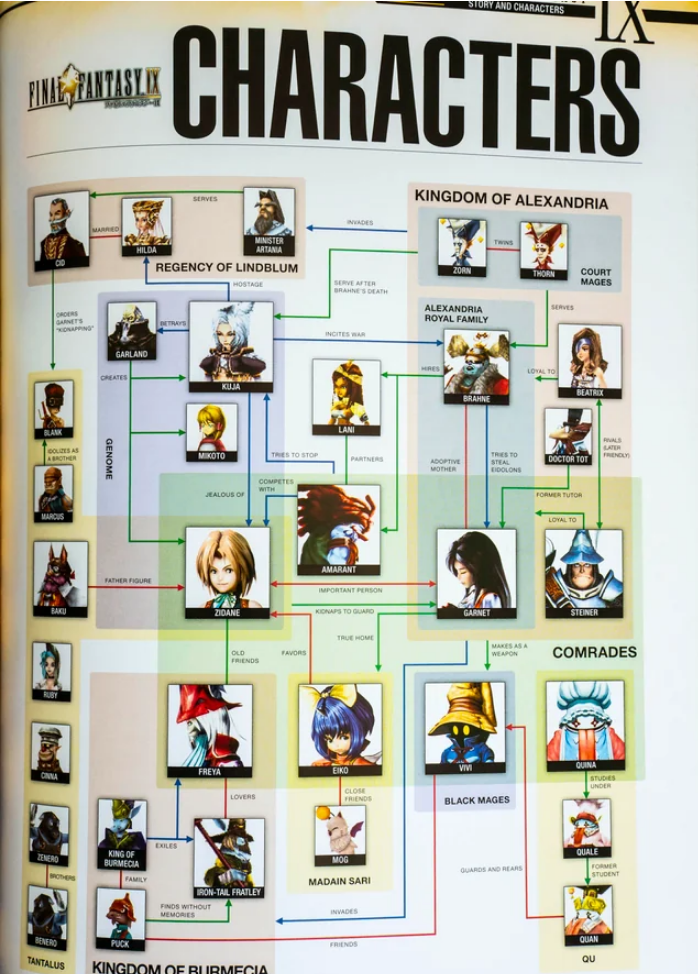
FF9 also only has one couple in its hero Zidane and heroine Garnet. They also have a mutual two-way arrow, this one saying “Important Person.”
So neither potential couple in FF7 – let alone only Cloti – is treated as canon in this book.
Conclusion
Translating is not an easy task, especially when it comes to English and Japanese. A literal translation rarely works, as certain nuances and cultural contextual cues contribute to the meaning of language as much as the dictionary definition of certain words. But Dark Horse went well beyond the territory of localizing subtext. Dark Horse flat out mistook or made up many of sentences they translated, and the result has had unfortunate implications for the love triangle debate.
Note that the only examples I’ve bothered providing are those that specifically relate to Cloud’s relationship with Aeris and Tifa. But if it is at all indicative of this translator’s work, then do not purchase this book. Dark Horse’s work lacks integrity and accuracy, and is not a useful tool in understanding the world of Final Fantasy VII and its characters – whether you ship Cloti or Clerith, you deserve something more accurate than a third-party translator’s personal head-canons about the game.
 Earth & Sky: A Cloud x Aeris Love Story