In Final Fantasy VII‘s gut-punch of an ending, Cloud defeats Sephiroth in the Northern Crater as Meteor descends upon the Planet. In volcanic eruptions of green Lifestream, Cloud sees Aeris above him, and reaches her hand out to hers. Afterwards, he and Tifa quickly climb to safe ground in the unstable terrain and share brief but meaningful words about the true nature of the Promised Land – and how Cloud believes he can meet Aeris again there.
However, some fans – specifically, those who prefer Tifa as Cloud’s romantic interest – object to the English translation, which centers around Cloud’s desire to reunite with Aeris. They argue that Cloud is not talking about Aeris at all, but rather, his deceased loved ones in general (his mother, Zack, and perhaps even Aeris.) Additionally, they argue that the pronoun Cloud uses in his statement shouldn’t be translated as “I”, but rather, “we” – suggesting he is inviting Tifa along.
Let’s look at the Japanese script, and how it compares to the English translation.
| Speaker | English (Official) | Japanese |
|---|---|---|
| Cloud | ……..Lifestream? | ……ライフストリム? |
| Cloud | …. I think I’m beginning to understand. | ….わかったような気がする |
| Tifa | What? | えっ? |
| Cloud | An answer from the planet… the Promised Land… | 星からの容え….約束の地…. |
| Cloud | I think I can meet her … there | そこで….会えると思うんだ |
| Tifa | Yeah, let’s go meet her. | うん、会いに行こう |
While plenty can be said about the quality of Final Fantasy VII’s English localization on a whole, here, the translation here in the ending is not incorrect. There is no real deviance between the two versions – each line here is a grammatically acceptable translation of the Japanese original.
The nuance of the argument is this: Japanese, as a language, typically omits pronouns when the topics in question are easily inferred. Cloud’s line, “I think I can meet her … there” in Japanese is: そこで….会えると思うんだ – which uses no pronouns, and thus what the words literally are is “I think [..] can meet […] there.”
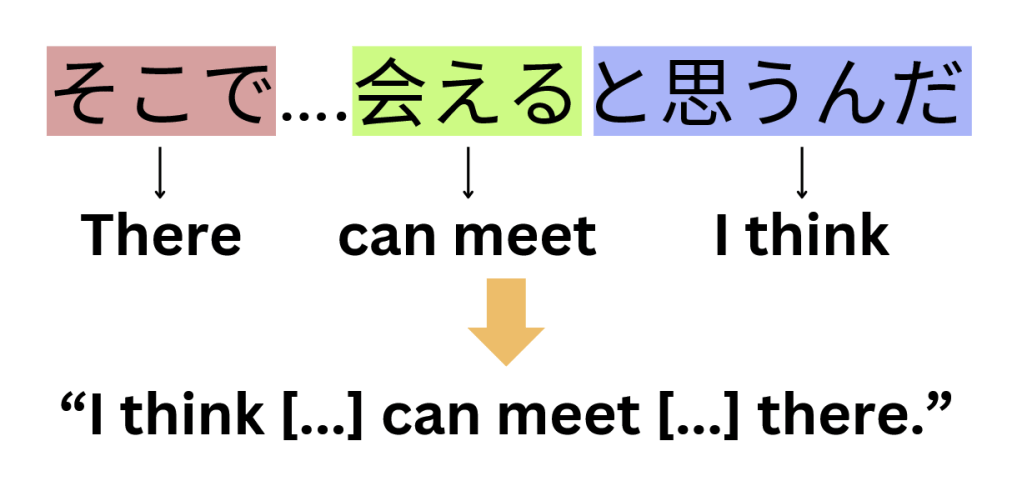
The translator here understood that Cloud had just seen the vision of Aeris, whose death is the biggest landmark trauma Cloud suffers over the course of the game. Aeris, a Cetra, also has a special connection with the Promised Land, which is supposedly a place of supreme happiness for the Cetra. Finally, when pronouns are omitted, it’s standard to translate them as first person assertions rather than insert plurals, which suggest an invitation in English that isn’t present in Japanese.

Furthermore, it should be noted that Cloud, in the ending FMV, cannot utter Aeris’s name, because FMVs have all dialogue directly embedded into the movie. In Final Fantasy VII, the player can give the characters whatever names they want, so FMVs can never use the names of any party members as a result.
Cloud’s dialogue here also bookmarks earlier lines by Aeris.

During their Gold Saucer date, Aeris tells Cloud, “I want to meet you.” In Japanese, this is “あなたに……会いたい” – which uses the same verb “meet” as Cloud’s line during the ending.
Another possible bookend for Cloud’s line is Aeris’s final words to him: when visiting him in a dream in the Sleeping Forest, she tells Cloud that she will “come back when it’s all over,” suggesting that they will one day reunite. For Cloud to be referring specifically to meeting Aeris again in the ending is a poignant connection between the two: he now sees a way this reunion can indeed happen, as Aeris said, now that the conflict is over.
However, certain Cloud/Tifa fans argue that the real translation should be “I think we can find them there,” thus erasing both Cloud asserting a personal desire as well as Aeris’s implied presence in his sentence. To be clear, there is no indication in the Japanese sentence 会えると思うんだ that suggests plural pronouns should be used, so this arguments rests on three items:
- An earlier storyboard of the scene where the topic of Cloud and Tifa’s conversation is different
- An ambiguous section from a book
- Wishful thinking
Let’s check out each of these.
Early Storyboard: The Other Side of the Mountain

Cloud: We’re going home, Tifa…
Tifa: Huh?
Cloud: We have something we need to do when we get back.
Cloud: We haven’t… seen the other side of that mountain.
Tifa: Yeah… let’s go home.
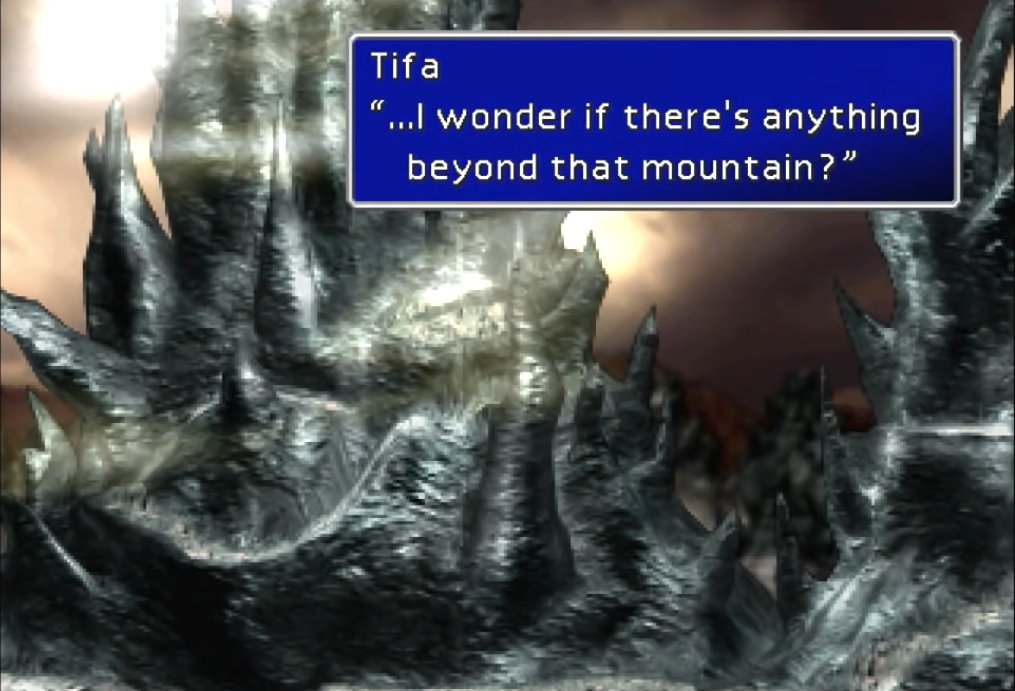
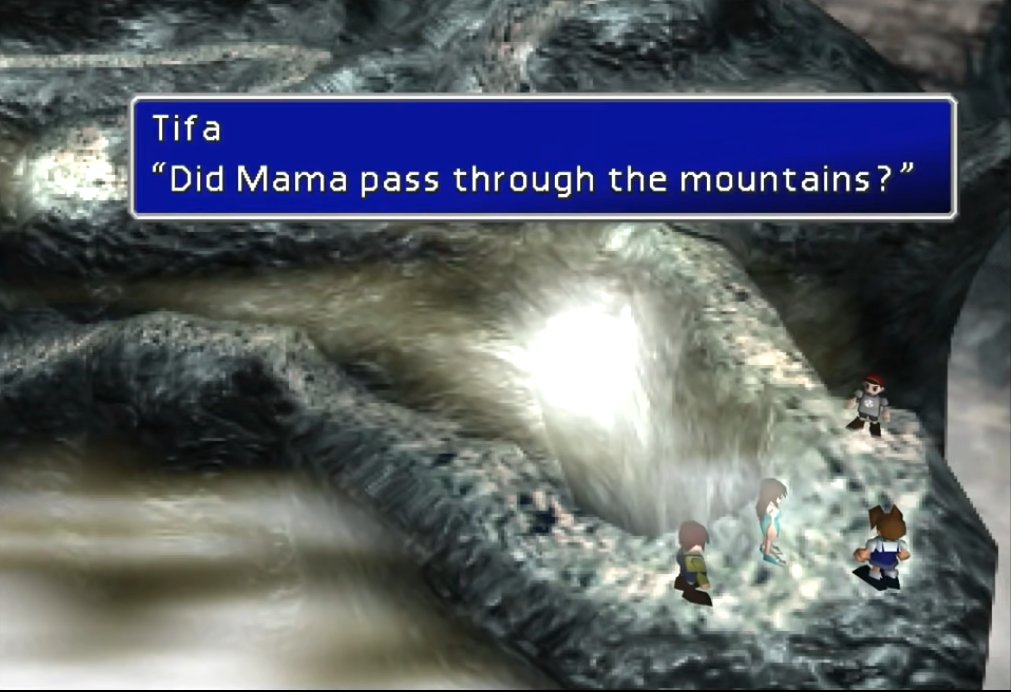
This calls back to a Nibelheim folk tale that suggests the souls of those who have died pass to the other side of Mount Nibel. During a flashback scene with Tifa, we see that when Tifa’s mother died, she tried to cross the mountain to find her mother’s soul.
This context gives this early storyboard ending a bit of a sting: ostensibly, Cloud is telling Tifa that they cannot die here in the Northern Crater because they still have to return to Nibelheim and find out what’s on the other side of the mountain. On the flip side, the mountain is a metaphor for death, suggesting Cloud is really saying they’re all going to die, but death means “going home to Mount Nibel” and crossing the other side. In that sense, Cloud could be trying to convey a morbid sense of comfort toward Tifa.
But of course, an early storyboard is just that – material that is ultimately different from the final game. For whatever reasons, the developers decided to delete this conversation and instead use a conversation about the nature of the Promised Land, which holds a special association with Aeris, instead.
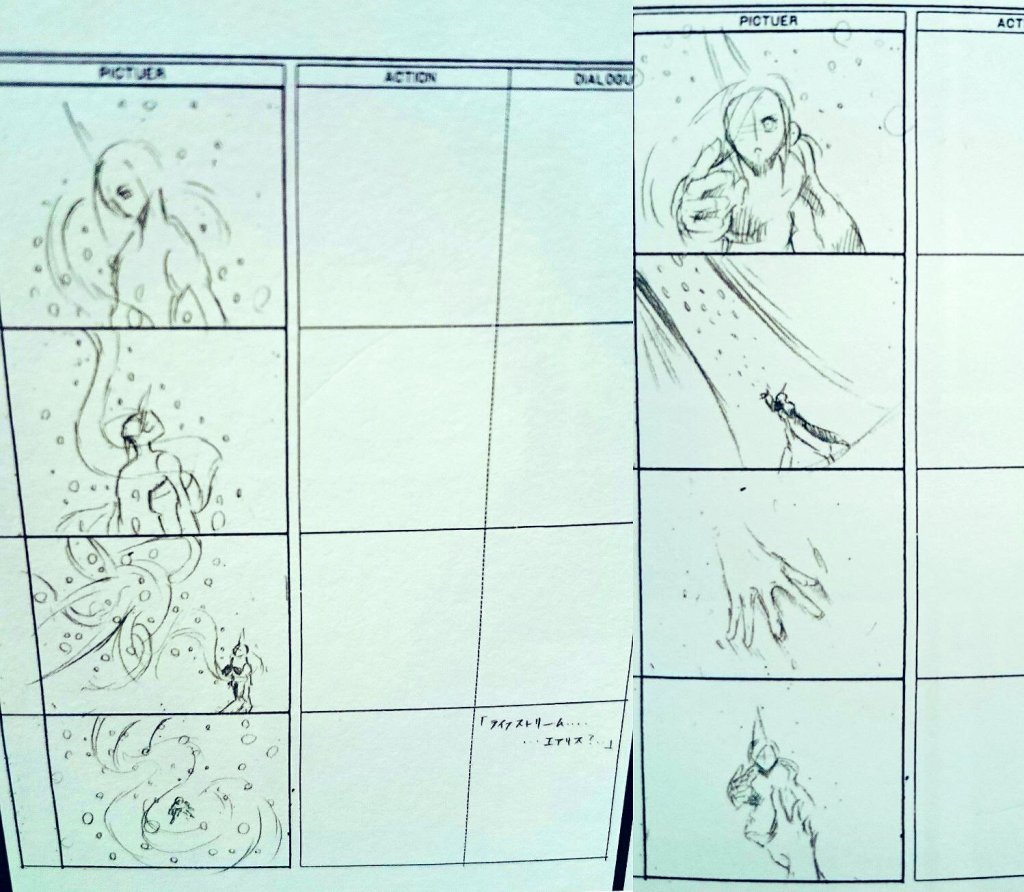
It’s worth pointing out that in these early storyboards, Cloud actually is written to say Aeris’s name as he senses her in the Lifestream.
Digicube’s Ambiguous Scene Description
Digicube was a subsidiary of Square that published various merchandise, including books, until it was dissolved following Square’s merger with Enix. In 2002, Digicube had released the Final Fantasy Complete Works Vol.2 VII through X book, containing basic plot and character information for Final Fantasy VII, VIII, IX, and X.
This book contains the following scene description:

クラウドとセフィロス
クラウドたちはセフィロスを倒した。だがセフィロスの肉体は滅んでも、精神はライフス トリームの流れに拡散することなく復活の気 配を見せる。クラウドは精神を飛ばし、セフ ィロスとの完全なる決着をつける。やがてライフストリームがクラウドを取り巻き、気が つくとティファの呼ぶ声が聞こえていた。クラウドは碧色の流れの中で、セトラが見つけ るという約束の地や、星が出した答えを見た ような気がした。そしてティファとふたり、 懐かしい人たちに、いつの日か会いに行こうと約束する。Unofficial translation
Cloud and Sephiroth
Cloud’s party defeated Sephiroth. However, even though Sephiroth’s body was destroyed, his spirit showed signs of returning without diffusing into the Lifestream’s flow. Cloud’s spirit launched off, and he was finally able to settle things with Sephiroth. Soon the Lifestream engulfed Cloud, and he suddenly heard Tifa calling out to him. Within the emerald flow, Cloud felt as if he saw the promised land that Cetra would find and the answer that the stars had given. He and Tifa promised together to go and see the people they missed someday.Final Fantasy Complete Works Vol.2 VII through X (Digicube)
While the description is fairly literal as to the events of the ending, it does not mention Aeris’s presence in the Lifestream, and declares that Cloud and Tifa promised to one day go and see the “people” they loved and missed. While certainly we can surmise that Aeris is among those people, this text makes room for the possibility of several lost loved ones. Perhaps Cloud is still referring to Aeris, but without him uttering her name nor her seeing Aeris’s vision herself, Tifa could be left to fill in the blanks with her own loved ones – Aeris, her father, her AVALANCHE comrades and the other lost villagers of Nibelheim.
However, in 2005, the Ultimania Omega was released. Instead of being a light anthology of many different Final Fantasy games, this guidebook was focused entirely on Final Fantasy VII. It contains the following passage:
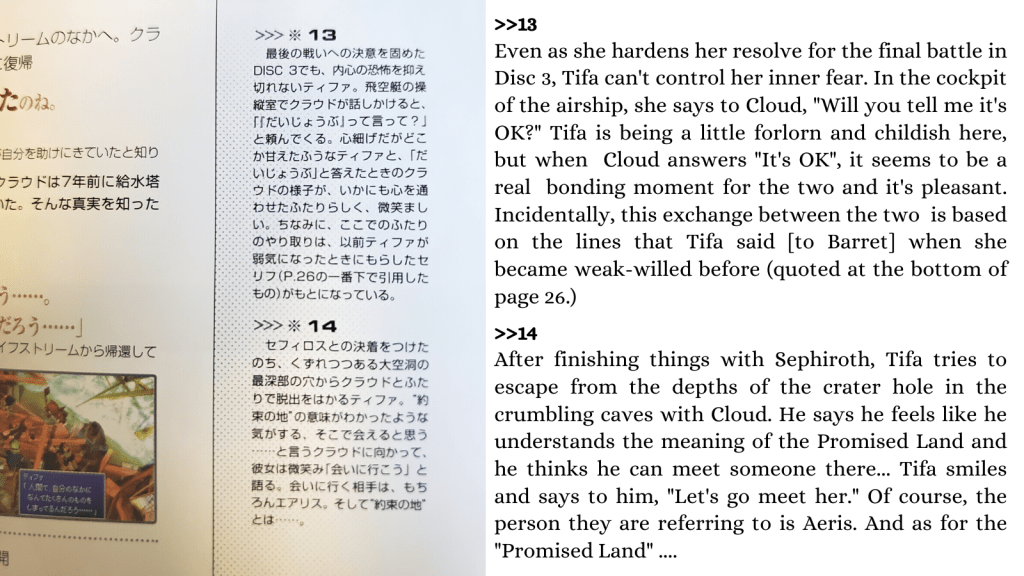
After finishing things with Sephiroth, Tifa tries to escape from the depths of the crater hole in the crumbling caves with Cloud. He says he feels like he understands the meaning of the Promised Land and he thinks he can meet someone there… Tifa smiles and says to him, “Let’s go meet her.” Of course, the person they are referring to is Aeris. And as for the “Promised Land” ….
-Ultimania Omega, Page 27
The text is beyond clear: “Of course, the person they are referring to as Aeris.” The tone implies as much is obvious, and leaves no room for suggesting they could be referencing multiple people. The Omega book was rereleased in 2020, making it additionally the most direct and recent source on the matter.
Furthermore, while the Ultimania series is continuously propped up as official guidebooks on Final Fantasy VII, the Complete Works vol 2 is largely forgotten to time. In the case of conflicting claims between the two works, there is no doubt that Omega holds more weight in terms of being an official reference.
Something else was released in 2005: the Advent Children DVD, and with it, a bonus video titled Reminiscence of Final Fantasy VII.
This segment, included as part of the DVD, is a short film that strings together key scenes to recap of the original game. What’s particularly interesting about it is the translation has been completely redone: rather than using the script from the 1997 English localization, Square retranslated each scene featured in the video.
This could be said to be a more definitive version of the script, given Square was able to fix errors and put more effort into polishing their game for overseas audiences. For instance:
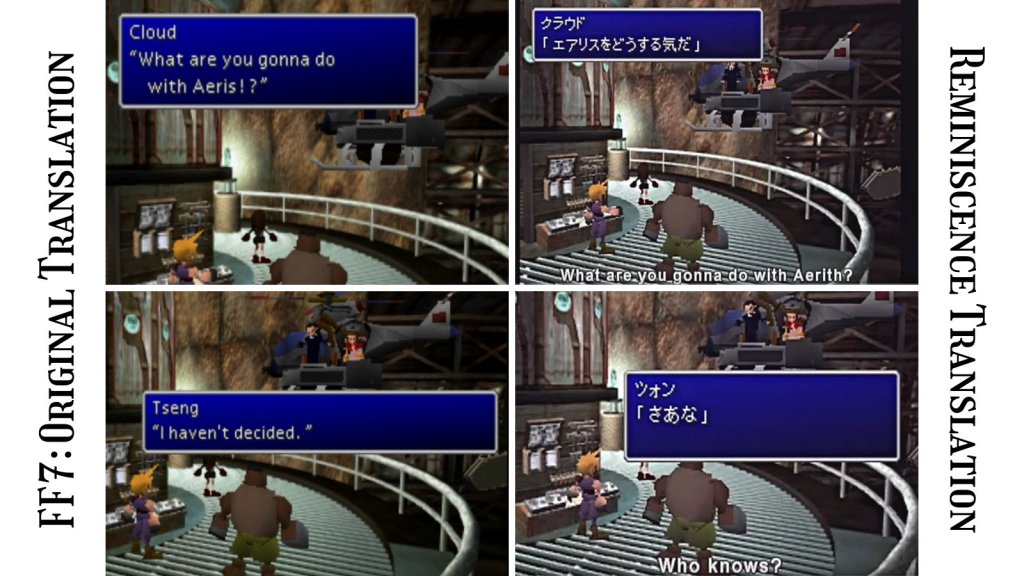
When Tseng confronts Cloud’s party on top of the Sector 7 pillar, Tseng answers “さあな” when Cloud asks him what he’s going to do with Aeris, whom he’s captured. The 1997 English version uses “I haven’t decided” as Tseng’s response, which, while technically a possible translation of さあな in isolation, makes no sense in context: Tseng isn’t undecided at all, his job is to deliver her to Hojo and he doesn’t know what Hojo will do to her. Thus, Reminiscence’s retranslation fixes the translation based on context: Tseng’s line is fixed to “Who knows?”
Therefore, if Cloud’s line “I think I can meet her there” were incorrect, this would be Square’s opportunity to set the record straight. In fact, Reminiscence does alter this line… but only to change “meet” to “find.”

I think I can find her there.
-Reminiscence of Advent Children, official translation
So not only is the subject definitively Aeris and not multiple people, the subject particle is still “I” – not “we.”
With two official translations of the line asserting Cloud as the topic and Aeris as the subject, there’s just no room for any valid conjecture otherwise. Which brings us to our final argument.
Wishful Thinking
The fact is, arguments about the validity of the English translation aren’t made out of genuine concern for the integrity of the language, but rather, they are fueled by shipping agendas. If one’s argument on why Cloud and Tifa should be or are a romantic couple rest on rewriting the official meaning of certain scenes, how strong indeed are these arguments?

Ultimately, the ending of Final Fantasy VII has Cloud express sentiments for only one of his love interests, and that is Aeris. We could infer a lot about what this means on a larger narrative level, or comment on how Aeris has a rather omnipotent presence in the ending, or how her face is the last one seen – right after Cloud’s – before the game’s end credits.
But the love triangle is meant to be open-ended and a matter of personal interpretation. Choosing a Tifa romance route is valid, and so is preferring Cloud and Tifa as a romantic couple. The fact that Aeris is so dear to Cloud need not be denied in order to construct the romantic interpretation of one’s personal choosing.
 Earth & Sky: A Cloud x Aeris Love Story