While it’s no great mystery what Final Fantasy VII Remake’s theme song Hollow could be about, the bluesy ballad has sparked years of internet debates nonetheless. Could the song, stated officially to be from Cloud’s point of view, be about his longing for his SOLDIER persona? Is it about Zack (or actually from Zack’s point of view)? Could it even be about Tifa, or all of Cloud’s friends?
No theory, however, has held a candle to the most likely possibility: it’s Cloud reflecting on losing Aerith, and yearning for a chance to save her this time. (You can read more about the lyrics, and how the song is used in Remake itself, here.)
Today, Survive Said the Prophet, who performed the original theme, released an official music video for a new power metal version of the song. The music video, branded with the logos of Survive Said the Prophet and Final Fantasy VII Remake, opens to a scene of lead singer Yosh rising from a church flowerbed – that is, of course, Aerith’s church. The song is performed in sets that invoke the industrial grunge of Midgar, until the brilliant purple sky at the end, calling to the ending scene of the game. A new lyric is added: Aerith’s final, pre-credits line, “I miss it, the steel sky.”
But that isn’t all. This music video also splices in scenes from the game itself, and, you guessed it, most of them are Cloud, Aerith, Cloud and Aerith, and Sephiroth.
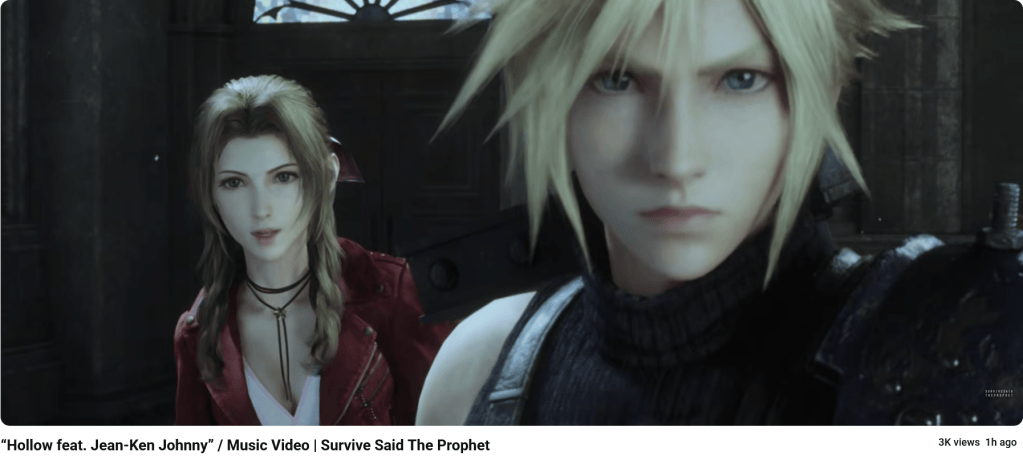
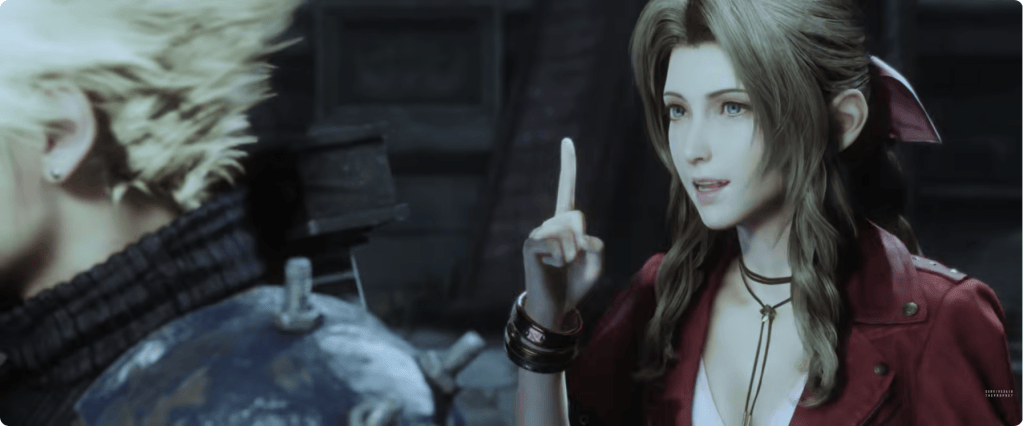
The first scenes are of Cloud during the first reactor mission, but after that, it jumps straight to Cloud and Aerith in Aerith’s church. We see Cloud protecting her from Reno, and Aerith promising Cloud one date.
During an additional heavy metal segment with the following new lyrics, Sephiroth appears, and we see flashes of his fiery confrontation with Cloud in chapter 2 during the aftermath of the reactor explosion.
This is the end
We’ll bleed until there’s nothing left
No glory left inside my name
Pain, pain , we bleed until there’s nothing left
We’ll choose to believe we’ll die for something
So when you call my name
From there, we go to scenes right before the final battle gauntlet, where the party stands in front of the portal to fight Destiny. (Remember how Cloud wants a do-over, and a chance to save her from her fate?) There’s a longer shot of Aerith at the end, focusing on her as she leads the mysterious new narrative.
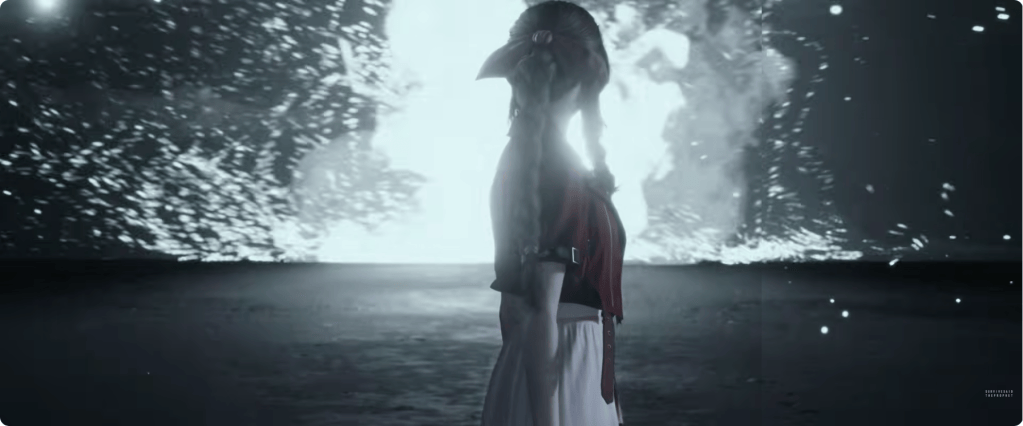
Next, there’s a scene of Cloud’s childhood memory on the water tower with Tifa. In this scene, Cloud expresses his desire to become a great hero. Then another standoff with Sephiroth during the simulation in Shinra HQ, where the pair stand back-to-back to a Midgar in flames from Meteor’s assault.
Cut to the original English version of Aerith’s final line, sampled into the song itself: “I miss it, the steel sky” – with Yosh posing under the same brilliantly-colored post-Midgar sky.

Interestingly, in this version of the song, the somber final stanza has been removed.
| Original version | New version |
| But I, I know, That you’re long gone But I, I will Go on, howling and hollow | Shine bright once more Guide me to you Smile bright once more This time ????? |
Rather than reflecting that Aeris is “long gone” and thus he’s hollow, this version reuses the previous lyrics, asking her to shine bright once more and guide him to her. The final line is difficult to understand, though fans report hearing different things, from “I will never let her go” to “Howling and hollow.”
This music video comes after the new version of the song was first teased earlier this summer. Check out the promo video:
Notice how Aerith’s White materia and Cloud’s Buster Sword are used as the cover’s symbols?
With little question left of who Hollow is about, all that’s left to wonder is what the greater intentions of this theme song are, and how it fits into the full Remake trilogy, especially with Revelation coming out next.
And while this cover was likely created independently, with permission from Nobuo Uematsu, by Survive Said the Prophet, it does suggest that the singer Yosh was told exactly what the song was meant to be about when he recorded the original – and that Yosh wanted to portray this from a new lens in his new version. After all, the tone is markedly different from the original. If the original was somber and reflective, Yosh’s new version is defiant and determined. Rather than longing contemplation, this version invokes the feeling of Cloud fighting – and winning – against the forces of fate that hold Aerith prisoner.

